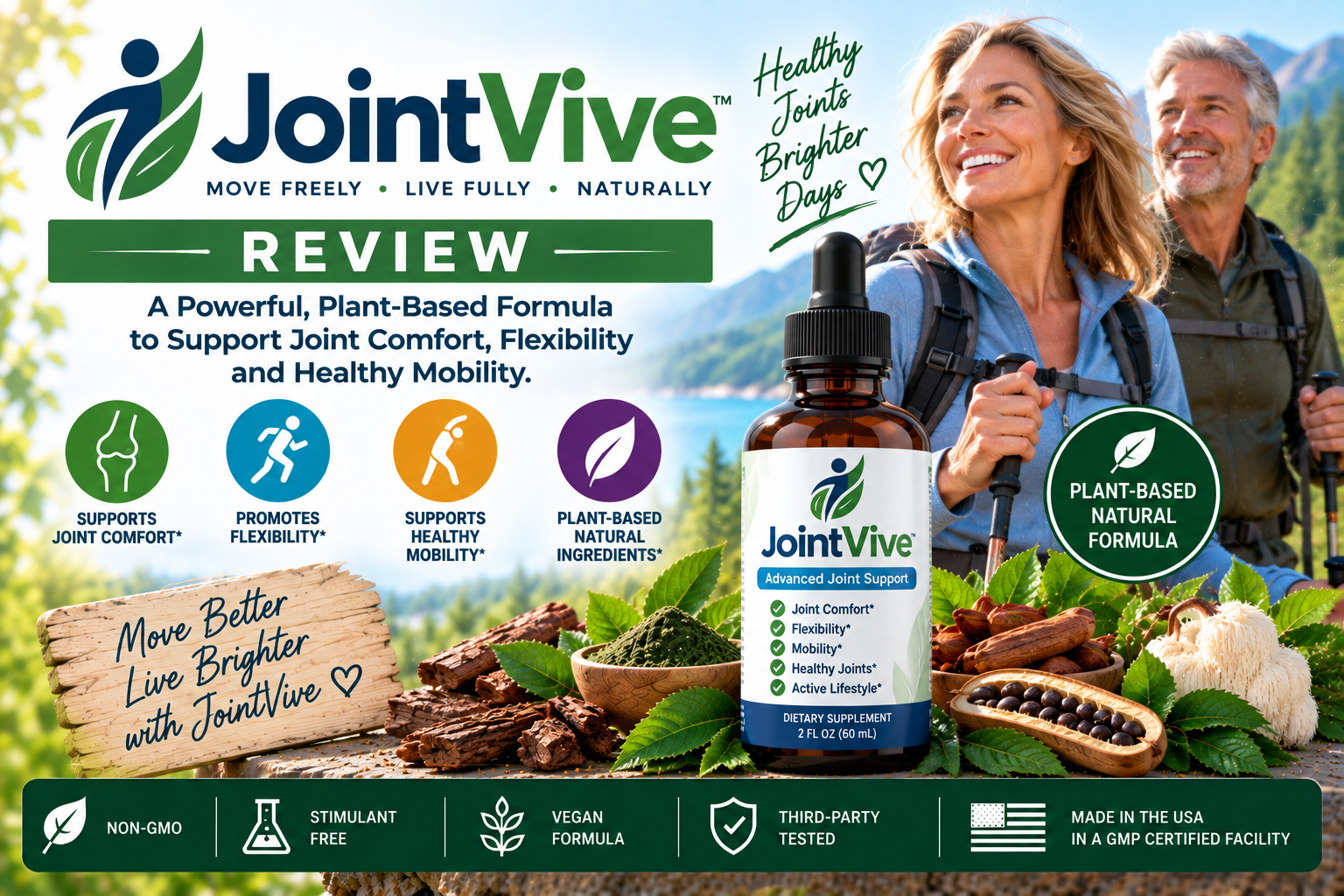
Joint discomfort and stiffness can make everyday activities—from walking and climbing stairs to gardening and exercise—considerably less enjoyable.
This explains the popularity of joint health supplements designed to support comfortable movement, flexibility and mobility.
JointVive is a plant-based liquid dietary supplement developed specifically around these goals.
According to the manufacturer, JointVive combines nine natural ingredients intended to support joint comfort, flexibility and overall mobility.
The formula includes:
- Pine Bark Extract
- Tamarind
- Chlorella
- Ginkgo Biloba
- Spirulina
- Lion’s Mane Mushroom
- Bacopa monnieri
- Moringa
- Neem
The manufacturer also promotes much stronger ideas involving inflammation, cartilage, collagen and the removal of fluoride from joints.
Some of these claims require considerably more caution.
In this independent JointVive review, we’ll examine the ingredients, potential benefits, joint-health claims, safety considerations and limitations to determine how convincing the formula really is.
This review is based on the manufacturer’s published product information and available ingredient research. We have not personally used or tested JointVive.
What Is JointVive?
JointVive is a liquid joint-health supplement designed primarily to support:
- Joint comfort
- Joint flexibility
- Healthy mobility
- Comfortable movement
- Long-term joint wellness
Unlike conventional joint supplements built around glucosamine, chondroitin or collagen, JointVive uses a collection of botanical, mushroom and algae-derived ingredients.
The current official product page describes the formula as natural, plant-based, non-GMO and stimulant-free.
It is also presented as easy to use and non-habit-forming.
This gives JointVive a somewhat unusual formulation compared with traditional joint supplements.
How Does JointVive Work?
JointVive’s basic concept is that its botanical compounds may provide nutritional, antioxidant and inflammatory-response support relevant to comfortable joint function.
That is the most reasonable way to interpret the formula.
Pine Bark Extract contains polyphenolic compounds that have been investigated for antioxidant and inflammatory pathways.
Tamarind has appeared in some joint-health research, while Moringa, Spirulina and several of the other ingredients contain plant compounds with antioxidant or inflammatory-response relevance.
The manufacturer takes this concept further by claiming JointVive removes accumulated fluoride from joints, increases collagen production and restores cartilage.
Those stronger mechanisms have not been established for the finished JointVive formula.
JointVive is therefore better viewed as a botanical joint-support supplement rather than a treatment capable of rebuilding damaged joints.
JointVive Ingredients
Pine Bark Extract
Pine Bark Extract is perhaps the most directly relevant joint-health ingredient in JointVive.
Pine bark contains polyphenolic compounds, particularly proanthocyanidins, with antioxidant properties.
A standardized French maritime pine bark extract known as Pycnogenol has been investigated in clinical studies involving osteoarthritis.
Some trials have reported improvements in symptoms such as discomfort, stiffness and physical function.
However, evidence reviews have also highlighted small study sizes and uncertainty surrounding the overall quality of the evidence.
Another important distinction is that research involving a particular standardized pine bark extract cannot automatically be applied to every generic pine bark ingredient.
Unless JointVive uses the same characterized extract at a comparable dose, the results aren’t directly transferable.
Pine Bark Extract nevertheless provides a plausible ingredient-level connection with joint comfort and mobility support.
Tamarind
Tamarind, or Tamarindus indica, is another interesting ingredient.
Tamarind seeds contain polyphenols and other bioactive plant compounds.
Specific standardized botanical combinations containing Tamarind seed extract have been investigated in randomized controlled studies involving knee discomfort and osteoarthritis.
Some of these studies have reported improvements in joint discomfort and physical function.
This provides a genuine scientific rationale for investigating Tamarind in joint-support formulations.
However, those trials evaluated particular standardized extracts—sometimes combined with turmeric or other ingredients.
They were not clinical trials of JointVive.
The amount and preparation of Tamarind in JointVive therefore matter when deciding how relevant those findings are.
Moringa
Moringa oleifera is a nutrient-rich plant containing polyphenols, flavonoids and other bioactive compounds.
It has attracted considerable research interest for antioxidant and inflammatory pathways.
Preclinical studies involving Moringa have explored mechanisms potentially relevant to inflammatory joint conditions.
Human evidence is developing but remains much less established than the marketing surrounding many Moringa supplements suggests.
Moringa may therefore contribute to the formula’s general antioxidant and inflammatory-response support, but claims that it rebuilds cartilage or makes damaged joints pain-free are considerably stronger than current evidence warrants.
Spirulina
Spirulina is a blue-green cyanobacterium widely used as a nutritional supplement.
It contains protein, pigments such as phycocyanin and various micronutrients.
Spirulina has been investigated for antioxidant and inflammatory effects.
This gives it some theoretical relevance to general wellness and inflammatory balance.
However, evidence that Spirulina supplementation directly rebuilds cartilage, substantially increases collagen or reliably relieves joint pain remains limited.
Its role in JointVive is therefore better regarded as broader nutritional and antioxidant support.
Lion’s Mane Mushroom
Lion’s Mane, or Hericium erinaceus, is a medicinal mushroom most commonly researched in relation to neurological and cognitive health.
It contains compounds including hericenones and erinacines that have attracted scientific interest.
Lion’s Mane also contains polysaccharides and other compounds with potential antioxidant or immune-related activity.
Its direct evidence for joint health is considerably weaker.
Claims that Lion’s Mane strengthens bones, preserves cartilage or removes toxins from joints shouldn’t be treated as established clinical effects.
Within JointVive, it is best regarded as a broader wellness ingredient rather than a proven joint-specific compound.
Ginkgo Biloba
Ginkgo Biloba is best known for research involving circulation and cognitive function.
Its leaves contain flavonoids and terpene lactones.
The manufacturer positions Ginkgo in JointVive around circulation and joint stiffness.
Good circulation is important for general tissue health, but this doesn’t establish Ginkgo as a conventional treatment for joint discomfort.
Its inclusion may contribute antioxidant and circulatory support, although the direct clinical evidence for meaningful improvements in osteoarthritis or everyday joint stiffness is limited.
Ginkgo can also interact with certain medications, particularly those affecting blood clotting.
Chlorella
Chlorella is a freshwater green alga used as a nutritional supplement.
It provides chlorophyll, carotenoids, protein and other nutrients.
The JointVive marketing places particular emphasis on Chlorella as a “detoxifier,” including claims that it helps remove fluoride and toxins.
This interpretation needs caution.
Chlorella has been investigated for various nutritional and environmental-exposure applications, but that does not demonstrate that JointVive removes clinically significant fluoride deposits from human joints.
Its inclusion is more reasonably viewed as providing nutritional and antioxidant compounds.
Neem
Neem, or Azadirachta indica, has a long history of traditional use.
Neem contains numerous biologically active plant compounds and has been investigated experimentally for inflammatory and antioxidant effects.
However, much of the evidence relevant to joint health remains preclinical.
This means laboratory or animal findings should not automatically be interpreted as proof that oral Neem supplementation relieves human joint pain.
Neem adds another botanical component to JointVive, but direct product-level evidence is needed before stronger conclusions can be made.
Bacopa Monnieri
Bacopa monnieri is another traditional botanical.
It is best known for its use in supplements targeting memory, cognition and stress.
Bacopa contains compounds known as bacosides and has antioxidant and other biological properties.
The manufacturer associates Bacopa with circulation, nerve function and protection from oxidative stress.
These mechanisms may have broader wellness relevance, but Bacopa isn’t an established mainstream joint-health ingredient.
Its direct contribution to JointVive’s joint-comfort effects is therefore uncertain.
Potential Benefits of JointVive
1. May Support Joint Comfort
Joint comfort is the central and most reasonable intended benefit of JointVive.
Several ingredients contain antioxidant or plant compounds investigated in pathways relevant to inflammatory balance.
Pine Bark Extract and Tamarind are particularly interesting from a joint-health perspective.
This doesn’t guarantee pain relief, but it provides a plausible rationale for the formula.
2. May Support Healthy Mobility
Comfortable joints naturally make movement easier.
The manufacturer therefore positions JointVive around healthy mobility.
If its ingredients help someone maintain joint comfort, that could potentially make walking and everyday movement feel easier.
However, significant mobility limitations can arise from arthritis, injury, neurological conditions and numerous other causes.
A supplement should not delay appropriate medical assessment.
3. May Support Joint Flexibility
Joint flexibility is another major keyword and product claim.
Stiffness can be influenced by inflammation, osteoarthritis, inactivity, muscle tightness and other factors.
JointVive may provide general nutritional support, but flexibility also depends heavily on regular movement, strength and appropriate exercise.
4. Provides Antioxidant Support
Pine Bark Extract, Moringa, Spirulina, Ginkgo, Neem and other ingredients contain compounds with antioxidant properties.
This gives JointVive a reasonable antioxidant-support component.
Oxidative stress has been investigated in ageing and several joint conditions.
However, antioxidant activity in a laboratory doesn’t automatically translate into clinically meaningful joint-pain relief.
5. May Support a Healthy Inflammatory Response
Several JointVive ingredients have been investigated for their interaction with inflammatory pathways.
That makes healthy inflammatory-response support a reasonable potential benefit.
It is preferable to claims that the supplement directly “eliminates inflammation.”
Inflammation is an important biological process, and chronic joint inflammation can have multiple causes requiring different forms of treatment.
6. May Complement an Active Lifestyle
For someone experiencing mild age- or activity-related joint discomfort, a botanical joint supplement may be one component of a broader wellness routine.
Maintaining comfortable movement can encourage continued physical activity.
Regular movement, resistance training and appropriate body-weight management can themselves be important for long-term joint health.
Does JointVive Relieve Joint Pain?
The manufacturer’s longer advertising pages make very strong joint pain relief claims.
Those claims should not be confused with established clinical evidence for the finished product.
Some individual ingredients have relevant research.
For example, standardized pine bark extracts have been studied in osteoarthritis, while particular Tamarind-containing formulations have shown encouraging results in clinical trials.
But JointVive itself would need appropriate randomized, placebo-controlled trials to demonstrate that its complete formula reliably reduces joint pain.
It is therefore more appropriate to say JointVive is designed to support joint comfort.
Does JointVive Reduce Joint Stiffness?
Potentially, although this hasn’t been established for the finished formula.
Joint stiffness can arise from osteoarthritis, inflammatory arthritis, previous injuries, inactivity and other causes.
Pine Bark Extract and several botanical ingredients have enough biological plausibility to make joint-comfort support reasonable.
But persistent morning stiffness—particularly when prolonged or accompanied by swelling—can sometimes indicate an inflammatory joint condition.
That deserves medical evaluation rather than relying solely on a supplement.
Can JointVive Rebuild Cartilage?
This is one of the stronger claims found in JointVive’s sales material.
There is currently insufficient evidence to conclude that taking JointVive rebuilds damaged human cartilage.
Cartilage biology is complex.
Once substantial structural damage has developed from osteoarthritis or injury, reversing it is extremely challenging.
Some nutritional compounds may support normal cartilage metabolism, but “supporting cartilage health” and regenerating lost cartilage are very different claims.
Consumers should be particularly sceptical of promises that a supplement will rapidly restore decades of cartilage damage.
Does JointVive Increase Collagen?
The manufacturer also claims the formula can increase collagen production.
Collagen is an important structural protein found in cartilage, tendons, ligaments, skin and other tissues.
The body synthesizes collagen naturally using amino acids and nutrients including vitamin C.
Some JointVive ingredients may influence pathways related to oxidative stress or tissue health.
However, this doesn’t establish that the complete product meaningfully increases joint collagen in humans.
Without direct clinical measurements, this remains a manufacturer claim rather than a proven JointVive effect.
JointVive and Fluoride: Does Fluoride Cause Joint Pain?
This is the most important scientific issue in JointVive’s marketing.
The longer sales presentation claims that toxic fluoride buildup inside the joints is the root cause of joint pain and stiffness.
That should not be presented as established fact.
Very high, chronic fluoride exposure can cause a genuine condition known as skeletal fluorosis.
Severe skeletal fluorosis can affect bones and joints and may cause pain or stiffness.
However, this condition is associated with excessive long-term fluoride exposure and is very different from saying ordinary joint pain or osteoarthritis is generally caused by fluoride accumulating in the joints.
For most people experiencing age-related knee, hip, shoulder or hand discomfort, fluoride isn’t established as the hidden universal root cause.
There is also insufficient evidence to conclude that JointVive removes fluoride from joints.
The fluoride narrative is therefore best regarded as a marketing theory rather than a clinically demonstrated mechanism for the product.
Is JointVive Good for Arthritis?
JointVive is a dietary supplement and should not be presented as an arthritis treatment.
Arthritis isn’t one condition.
Osteoarthritis involves structural and biological changes within joints, while rheumatoid arthritis and several other forms are inflammatory or autoimmune diseases.
Some JointVive ingredients have been studied in areas relevant to osteoarthritis.
That doesn’t mean the finished product has been demonstrated to treat arthritis.
Anyone with persistent pain, swelling, redness, warmth or significant loss of movement should seek appropriate assessment.
JointVive for Knee Joint Support
Knees are among the most common joints affected by age- and activity-related discomfort.
Some ingredient research relevant to JointVive has specifically involved knee function.
Studies of certain standardized Tamarind combinations have reported improvements in knee discomfort and physical-function measurements.
Pine bark research has also included people with knee osteoarthritis.
These studies make the ingredients interesting.
But because the preparations and doses used in those trials may differ from JointVive, they shouldn’t be treated as direct proof that JointVive produces the same outcomes.
JointVive for Healthy Ageing
Maintaining joint mobility with age can have benefits far beyond the joints themselves.
Comfortable movement makes it easier to remain physically active.
Physical activity helps support muscle strength, cardiovascular health, balance and independence.
JointVive may therefore appeal particularly to older adults interested in maintaining comfortable movement.
But strength training, appropriate aerobic activity, adequate protein and professional treatment of existing joint conditions remain considerably more important foundations.
How Do You Take JointVive?
There is currently an important inconsistency in JointVive’s published directions.
The main official product page recommends one drop per day, preferably in the morning.
It says the drop can be taken directly or added to tea, coffee, juice or another beverage and recommends shaking the bottle first.
However, a longer JointVive sales presentation gives different directions, describing a full dropper under the tongue twice daily.
Because these instructions conflict, consumers should not guess which dose to use.
The safest approach is to follow the directions printed on the current physical bottle supplied with the order and contact the manufacturer if those instructions are unclear.
Increasing the amount because a sales page suggests faster results would not be advisable.
How Long Does JointVive Take to Work?
There is no independently established timeframe showing when JointVive should produce noticeable results.
The marketing materials contain claims ranging from improvements within days or weeks to recommendations involving many months of continued use.
Individual experiences with joint discomfort can vary considerably.
Someone assessing a joint supplement should pay attention to meaningful outcomes such as walking comfort, stiffness, range of movement and ability to perform normal activities rather than relying only on subjective marketing promises.
Persistent or worsening symptoms warrant medical assessment.
Is JointVive Natural?
According to the current manufacturer information, JointVive is promoted as:
- A natural formula
- Plant-based
- Non-GMO
- Stimulant-free
- Easy to use
- Non-habit-forming
The manufacturer also states that its ingredients are tested for purity and checked for toxins and contaminants.
The longer sales page says JointVive is manufactured in the USA using domestic and foreign ingredients.
These are useful product characteristics, although manufacturing claims do not establish clinical effectiveness.
Is JointVive Safe?
“Natural” doesn’t mean automatically risk-free.
JointVive contains nine biologically active ingredients.
Ginkgo Biloba, for example, can interact with medications that affect blood clotting and may be unsuitable for some people around surgery.
Botanical ingredients can also produce allergies, gastrointestinal effects or interactions in susceptible individuals.
The manufacturer’s own terms advise people who are pregnant, nursing, taking medication or managing a medical condition to consult a physician before using the product.
This is particularly sensible for a multi-ingredient formula.
JointVive Side Effects
The official product information doesn’t establish that everyone will tolerate JointVive without adverse effects.
Possible effects will depend on dose, individual sensitivity and medication use.
Botanical supplements can potentially cause:
- Digestive discomfort
- Nausea
- Headache
- Allergic reactions
- Medication interactions
The exact quantities of the individual ingredients are also important when assessing safety.
Anyone experiencing a significant reaction should stop using the product and seek appropriate medical advice.
JointVive Limitations
The Fluoride “Root Cause” Claim Is Not Established
This is the largest limitation.
Extreme chronic fluoride exposure can cause skeletal fluorosis, but that doesn’t mean normal joint pain is generally caused by fluoride accumulating inside joints.
The marketing takes a genuine toxicological phenomenon and extends it far beyond what the evidence supports.
Finished-Product Clinical Evidence Is Limited
Research involving individual ingredients isn’t the same as research involving JointVive.
A randomized controlled trial testing the exact commercial formula against placebo would provide far stronger evidence.
Exact Ingredient Doses Matter
The current public-facing product information emphasizes the nine ingredients but doesn’t provide enough dose information to confidently compare each ingredient with amounts used in published clinical research.
This makes efficacy difficult to evaluate.
Some Ingredients Are More Joint-Specific Than Others
Pine Bark Extract and Tamarind have the clearest direct connections with published joint research.
Ingredients such as Lion’s Mane and Bacopa are better known for other areas of research.
A nine-ingredient formula may sound comprehensive, but the number of ingredients alone doesn’t determine effectiveness.
Dosage Instructions Are Inconsistent
The conflict between one drop daily and one full dropper twice daily is a practical weakness.
Clear and consistent serving instructions are particularly important for multi-ingredient dietary supplements.
Testimonials Aren’t Clinical Evidence
JointVive’s longer sales presentation contains dramatic testimonials about rapid improvements in pain and mobility.
Testimonials can describe individual experiences.
They cannot establish typical effectiveness, determine causation or replace controlled clinical trials.
JointVive Money-Back Guarantee
JointVive currently advertises a 365-day, 100% money-back guarantee.
The manufacturer’s order information states that customers can return the product within 365 days if dissatisfied.
The detailed guarantee says this can include empty bottles, with the refund provided less shipping and handling.
This is a notably longer refund period than many supplements offer.
Consumers should still read the current return instructions and conditions when ordering because commercial policies can change.
Who Might Consider JointVive?
JointVive may appeal to adults who:
- Want additional joint-health support
- Experience occasional age- or activity-related joint discomfort
- Want to support joint flexibility
- Are interested in maintaining healthy mobility
- Prefer a liquid supplement
- Prefer plant-based ingredients
- Want a stimulant-free joint formula
- Are interested in Pine Bark Extract and Tamarind
- Understand that supplements don’t rebuild severely damaged joints
- Have realistic expectations about joint-support products
It is less suitable as a self-treatment strategy for unexplained severe joint pain, rapidly worsening symptoms or suspected inflammatory arthritis.
JointVive vs Traditional Joint Supplements
JointVive is unusual because it doesn’t follow the classic glucosamine, chondroitin and MSM formula used by many joint supplements.
Instead, it relies on botanical, mushroom and algae-derived ingredients.
That may appeal to consumers who want a different approach.
Pine Bark Extract and Tamarind are particularly interesting inclusions.
However, an unconventional formula isn’t automatically superior to established joint-health ingredients.
The strength of any supplement ultimately depends on the quality, dose and clinical evidence for the finished formulation.
Supporting Joint Health Naturally
Supplements should form only a small part of a broader joint-health strategy.
Regular movement is particularly important.
Appropriate resistance exercise can strengthen the muscles surrounding joints, potentially improving stability and physical function.
Maintaining a healthy body weight can reduce mechanical stress on weight-bearing joints such as the knees and hips.
A balanced diet supplying sufficient protein, vitamins, minerals and essential fatty acids also supports overall musculoskeletal health.
For existing osteoarthritis, structured exercise and appropriate professional guidance can often be extremely valuable.
Avoiding movement entirely because a joint feels stiff can sometimes contribute to further weakness and reduced function.
The appropriate activity depends on the underlying condition.
When Joint Pain Needs Medical Attention
Not all joint discomfort should be managed with supplements.
Medical assessment is particularly important when pain is:
- Severe or rapidly worsening
- Associated with substantial swelling
- Accompanied by redness or warmth
- Associated with fever
- Caused by a significant injury
- Preventing normal weight-bearing
- Associated with prolonged morning stiffness
- Persisting despite appropriate self-care
Sudden hot, swollen joints can sometimes require urgent assessment.
A supplement should never delay diagnosis of a potentially significant joint condition.
JointVive and Long-Term Mobility
One of the strongest aspects of JointVive’s positioning is its emphasis on mobility.
Maintaining mobility is genuinely important for healthy ageing.
But mobility is influenced by far more than cartilage alone.
Muscle strength, balance, cardiovascular fitness, neurological function, joint range of motion and confidence all contribute.
This is why combining appropriate exercise with weight management and professional treatment where needed generally provides a stronger long-term strategy than relying exclusively on a supplement.
JointVive could potentially complement that strategy.
It should not replace it.
Final Verdict: Is JointVive Worth Trying?
JointVive is a plant-based liquid joint supplement designed to support joint comfort, flexibility and overall mobility.
Its nine highlighted ingredients are:
Pine Bark Extract, Tamarind, Chlorella, Ginkgo Biloba, Spirulina, Lion’s Mane Mushroom, Bacopa monnieri, Moringa and Neem.
There are some interesting ingredients here.
Pine Bark Extract has been investigated in osteoarthritis research, although the overall evidence remains uncertain and studies often involve specific standardized extracts.
Tamarind is also promising: particular standardized Tamarind-containing botanical formulations have produced encouraging results in controlled trials involving knee discomfort and function.
Several other ingredients provide plausible antioxidant or inflammatory-response support.
Where JointVive becomes substantially less convincing is its stronger marketing narrative.
The claim that toxic fluoride buildup is the hidden root cause of ordinary joint pain isn’t established.
Likewise, promises involving rapid pain elimination, cartilage rebuilding, collagen restoration or permanently reversing joint damage go considerably beyond what can currently be concluded from the evidence for the finished product.
There is also a notable inconsistency in the published directions, with different JointVive pages recommending different amounts.
For adults interested in a plant-based joint-health supplement, JointVive has a distinctive formula and may be worth considering after reviewing the current label and checking for medication interactions.
Its natural, plant-based, non-GMO and stimulant-free positioning and current 365-day money-back guarantee are additional practical positives according to the manufacturer.
Overall, JointVive is best viewed as an optional botanical supplement that may support joint comfort, flexibility and healthy mobility.
It should not be viewed as a proven treatment for arthritis, a method for removing fluoride from joints, or a clinically demonstrated way to regenerate damaged cartilage.
The ingredient profile is more credible than the strongest advertising claims.
👉 To learn more please click here to visit the product website.
Leave a Reply
You must be logged in to post a comment.