Persistent ringing, buzzing, hissing or other unwanted sounds can have a significant effect on concentration, relaxation and sleep.
It is therefore understandable that supplements designed around ear health, hearing support and auditory wellness attract considerable interest.
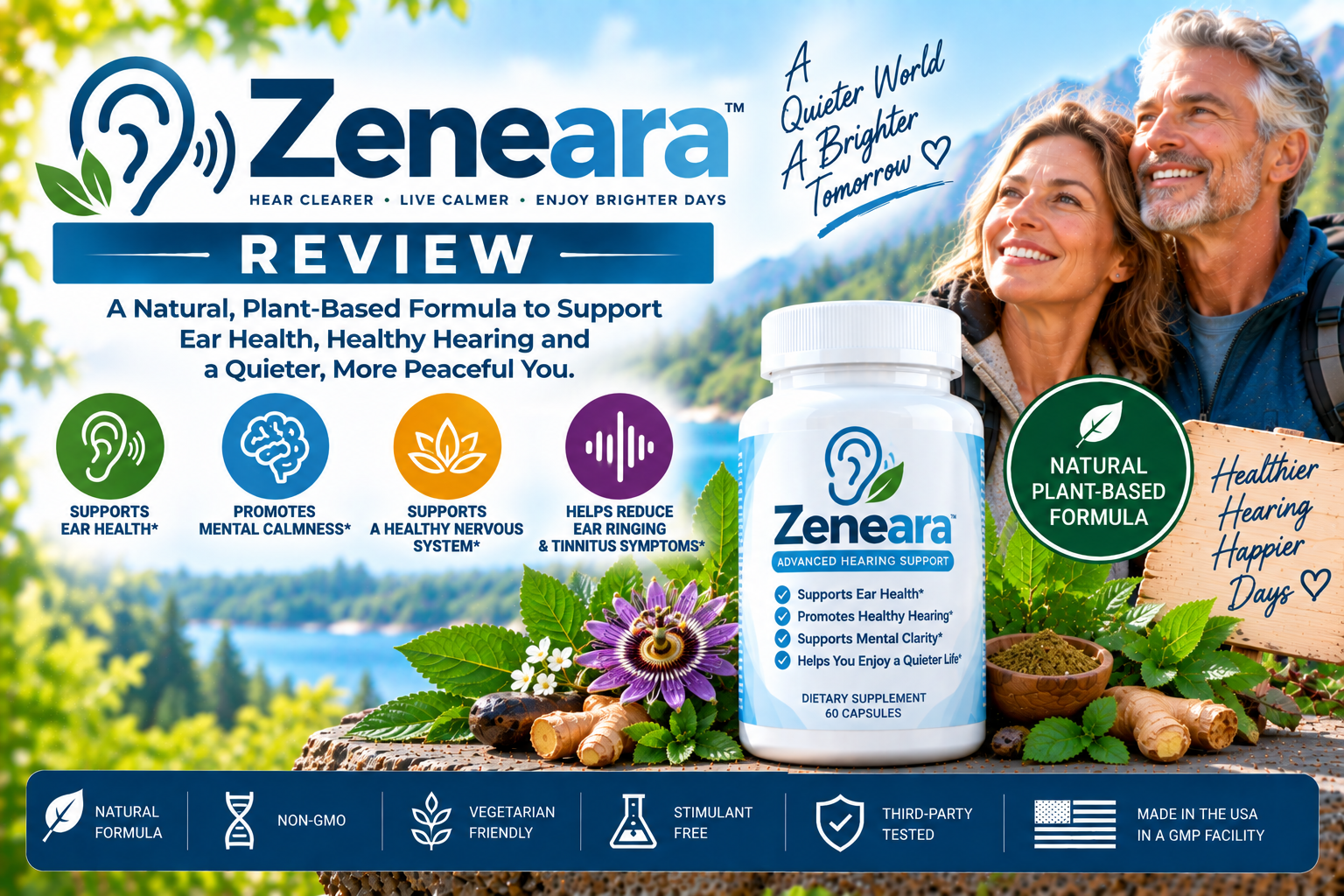
Zeneara is a dietary supplement marketed specifically to support the health of the ears.
According to the current Zeneara VIP product page, its formula is designed to support the nerve environment of the ear and provide nutritional support for healthy ear function.
The current page highlights seven main ingredients:
- Passion Flower Powder
- Vitamin B6
- Zinc
- Ginkgo biloba Extract
- Probiotic Blend
- Taurine
- Valerian Extract
Zeneara’s broader marketing also focuses heavily on ear ringing and tinnitus, with claims involving GABA, glutamate and the balance of neurotransmitters within the brain.
Some of the ingredients have legitimate nutritional or neurological relevance.
However, claims that Zeneara can eliminate tinnitus, rebalance the brain or permanently restore hearing require considerably more caution than the advertising suggests.
In this independent Zeneara review, we’ll examine the ingredients, potential benefits, tinnitus claims, ear-health evidence, safety considerations and limitations.
This review is based on the manufacturer’s published product information and available ingredient research. We have not personally used or tested Zeneara.
What Is Zeneara?
Zeneara is a capsule-based dietary supplement designed around ear health and healthy hearing.
The current manufacturer’s VIP page asks consumers what they are doing to “support their ears” and describes Zeneara as providing ingredients intended to support the nerve environment of the ear.
Across the manufacturer’s current promotional material, the main themes include:
- Ear health
- Healthy hearing
- Hearing support
- Auditory wellness
- Ear ringing
- Tinnitus
- Buzzing
- Hissing
- Whooshing
- Brain health
- GABA support
- Nervous-system support
- Relaxation
- Stress support
- Mental calmness
The current VIP page describes Zeneara as a natural, vegetarian and non-GMO formula.
It is also marketed as stimulant-free and non-habit-forming.
Each current bottle contains 60 capsules, providing approximately a one-month supply when used according to the manufacturer’s twice-daily directions.
How Does Zeneara Work?
Zeneara’s marketing focuses on the relationship between the ears, nervous system and brain.
That broad connection is scientifically reasonable.
Hearing isn’t performed by the ears alone.
Sound entering the ear is converted into electrical signals that travel through auditory pathways toward the brain, where those signals are interpreted.
Tinnitus is also increasingly understood as involving complex activity within auditory and neurological pathways.
The manufacturer’s more aggressive sales material proposes a much more specific mechanism.
It argues that excessive glutamate and insufficient activity of the inhibitory neurotransmitter GABA produce an imbalance responsible for ear ringing.
Zeneara is then presented as a way of restoring that balance.
GABA and glutamate genuinely are important neurotransmitters.
However, tinnitus doesn’t have one universal neurochemical cause.
Describing tinnitus simply as a GABA/glutamate imbalance—and implying that a supplement can correct that imbalance and permanently eliminate the noise—is an oversimplification.
A more evidence-conscious interpretation is that Zeneara combines nutrients, amino acids, probiotics and calming botanicals intended to provide general neurological, stress and ear-health support.
Zeneara Ingredients
The current VIP page describes Zeneara as containing seven highlighted ingredients.
Other official Zeneara sales pages describe eight ingredients by listing particular probiotic strains separately.
Because formulas and product pages can change, consumers should check the Supplement Facts panel on the physical bottle they receive.
Passion Flower Powder
Passion Flower, or Passiflora incarnata, is traditionally associated with relaxation and stress support.
The Zeneara manufacturer says Passion Flower has traditionally been used to promote relaxation and reduce feelings of stress and anxiety.
That makes it relevant to a formula targeting people troubled by persistent ear noise.
Stress doesn’t necessarily cause tinnitus, but tinnitus and stress can reinforce each other.
When someone becomes anxious about an unwanted sound, the sound may become increasingly difficult to ignore.
A botanical that supports relaxation could therefore potentially help someone feel less distressed by tinnitus.
That is different from demonstrating that Passion Flower eliminates the underlying auditory signal.
Vitamin B6
Vitamin B6 is an essential vitamin involved in numerous metabolic processes.
It contributes to:
- Normal energy metabolism
- Neurotransmitter synthesis
- Nervous-system function
- Protein metabolism
- Red-blood-cell formation
Its neurological role makes Vitamin B6 relevant to a supplement marketed around the nervous system.
However, taking additional Vitamin B6 beyond nutritional requirements hasn’t been established as a universal treatment for tinnitus.
Dosage matters too.
Very high supplemental intakes of Vitamin B6 over prolonged periods can cause peripheral neuropathy.
Consumers should therefore consider their total Vitamin B6 intake from Zeneara and any other supplements they use.
Zinc
Zinc is an essential mineral involved in immune function, protein synthesis, wound healing and numerous enzymatic reactions.
It has also been investigated specifically in relation to tinnitus.
Some people with tinnitus may have low Zinc status, and several studies have investigated whether supplementation improves symptoms.
Results have been inconsistent.
Zinc may be more relevant when an actual deficiency exists, but evidence doesn’t support treating it as a universal tinnitus remedy.
Long-term excessive Zinc intake can also interfere with Copper absorption.
More isn’t necessarily better.
Ginkgo Biloba Extract
Ginkgo biloba—also known as the Maidenhair Tree—is probably one of the most recognizable ingredients in supplements marketed for tinnitus and cognitive health.
Ginkgo contains flavonoids and terpene lactones and has been investigated for:
- Circulation
- Antioxidant activity
- Cognitive function
- Tinnitus
The evidence for tinnitus is mixed.
Some individual studies involving particular standardized Ginkgo extracts have reported benefits, while systematic reviews have generally found insufficient or inconsistent evidence for treating tinnitus overall.
This distinction is important because Ginkgo biloba extract isn’t automatically equivalent to a clinically studied standardized extract.
Zeneara’s current VIP page describes Ginkgo as potentially supporting circulation and antioxidant activity while helping maintain ear health.
That is a more defensible expectation than promising that it will eliminate tinnitus.
Probiotic Blend
The current Zeneara VIP page lists a Probiotic Blend.
It describes probiotics primarily around digestive health, immune function and overall wellbeing.
Other official Zeneara promotional pages identify Lactobacillus brevis and Lactobacillus paracasei as particularly important strains.
The manufacturer’s theory connects these probiotics with the gut-brain axis and GABA production.
The gut-brain axis is a genuine and active field of scientific research.
Gut microorganisms can influence metabolites and signalling molecules associated with neurological function.
Certain bacterial strains can also produce GABA under particular conditions.
However, this doesn’t establish that taking a probiotic orally meaningfully increases GABA inside the human brain or eliminates tinnitus.
The blood-brain barrier and broader neurobiology make that interpretation considerably more complicated.
Zeneara’s probiotics therefore have a reasonable role in digestive and general wellness support, while their tinnitus-specific effects remain much more speculative.
Taurine
Taurine is an amino-sulfonic acid naturally present throughout the body.
It is involved in numerous physiological processes, including:
- Nervous-system function
- Cardiovascular health
- Cellular hydration
- Antioxidant defence
- Calcium signalling
Zeneara’s manufacturer emphasizes Taurine in relation to GABA activity and glutamate.
There is legitimate scientific interest in Taurine’s neurological effects.
Preclinical research has explored Taurine in auditory and neurological models.
However, laboratory and animal findings shouldn’t be treated as proof that Taurine supplements eliminate tinnitus in humans.
The current VIP page uses more restrained language, describing Taurine as supporting nerve function and cardiovascular health while potentially contributing to overall wellbeing and ear health.
That is a more appropriate interpretation.
Valerian Extract
Valerian, or Valeriana officinalis, is a botanical widely used in relaxation and sleep supplements.
It has a long history of traditional use for:
- Relaxation
- Sleep
- Nervous tension
- Stress
Zeneara includes Valerian around its calming and GABA-oriented concept.
This could be relevant to people whose tinnitus becomes especially intrusive at night.
Reducing stress or supporting sleep may make persistent ear noise easier to cope with.
Again, this shouldn’t be confused with eliminating the underlying tinnitus itself.
Valerian can also cause drowsiness in some people and may interact with sedating substances or medications.
Why Do Some Zeneara Pages List Eight Ingredients?
There is an important inconsistency across the current official Zeneara website.
The VIP page supplied for this review describes seven highlighted ingredients:
Passion Flower, Vitamin B6, Zinc, Ginkgo biloba, Probiotic Blend, Taurine and Valerian.
Other official Zeneara sales material refers to eight ingredients and identifies the probiotics Lactobacillus brevis and Lactobacillus paracasei separately.
This may simply reflect different ways of presenting the probiotic blend or different versions of the sales material.
Nevertheless, supplement transparency matters.
Consumers should use the current physical Supplement Facts label as the definitive source for the formula in the bottle they actually receive.
Potential Benefits of Zeneara
1. May Support Ear Health
Zeneara is primarily positioned as an ear health supplement.
Its combination of Zinc, Ginkgo, Taurine, Vitamin B6 and other ingredients provides a reasonable nutritional basis for general neurological and auditory wellness.
That doesn’t establish the formula as a treatment for hearing loss.
2. May Support the Nerve Environment of the Ear
This is the principal wording used on the current Zeneara VIP page.
Vitamin B6 participates in normal nervous-system function.
Taurine also has neurological roles, while Ginkgo has been investigated for antioxidant and circulatory effects.
Together, these ingredients provide some rationale for nutritional nervous-system support.
Claims of repairing or regenerating damaged auditory nerves would require considerably stronger evidence.
3. May Support Relaxation
Passion Flower and Valerian are both traditional calming botanicals.
This may be particularly relevant because tinnitus can become more intrusive during periods of anxiety or stress.
Reducing stress may help someone respond less strongly to persistent ear noise.
That is a meaningful potential benefit even if the actual auditory signal remains unchanged.
4. May Support Sleep and Night-Time Calmness
Ear ringing can become particularly noticeable in a quiet bedroom.
Valerian and Passion Flower may provide relaxation support, potentially making Zeneara interesting to people who find tinnitus especially disruptive at night.
However, Zeneara isn’t a replacement for appropriate assessment of chronic insomnia or severe tinnitus-related sleep disturbance.
5. Provides Antioxidant Support
Ginkgo and several other components of the formula contain compounds with antioxidant activity.
Oxidative stress has been investigated as one factor potentially involved in auditory-system health.
Providing antioxidant nutrients may therefore complement general wellness.
Antioxidant activity alone doesn’t demonstrate that Zeneara repairs damaged hearing.
6. May Support General Nervous-System Wellness
Vitamin B6 and Taurine both have established biological relevance to neurological function.
The formula’s calming botanicals add another dimension.
This makes nervous-system support a more reasonable description of Zeneara than claims of permanently correcting a specific brain chemical imbalance.
Zeneara and Tinnitus
Although the VIP page uses relatively restrained ear-health language, Zeneara’s broader marketing clearly targets people with tinnitus.
The sales presentation repeatedly references:
- Ringing
- Buzzing
- Hissing
- Whooshing
- Clicking
- Whistling
Tinnitus is the perception of sound when no corresponding external sound is present.
It isn’t a single disease.
Instead, it is a symptom that can be associated with many different auditory, neurological and medical factors.
This complexity matters when evaluating Zeneara.
Does Zeneara Stop Ear Ringing?
There isn’t sufficient evidence to conclude that Zeneara reliably stops ear ringing.
The manufacturer’s stronger sales pages claim that its ingredients can rebalance brain chemistry and make tinnitus disappear.
Those claims go beyond what can currently be established for the finished product.
Ginkgo has been investigated in tinnitus research, but results are mixed.
Zinc has also been studied, particularly where deficiency may be relevant.
Passion Flower and Valerian may support relaxation.
Taurine has interesting neurological properties.
None of that establishes that the complete Zeneara formula permanently eliminates tinnitus.
Is Tinnitus Caused by Low GABA and High Glutamate?
This theory features heavily in Zeneara’s advertising.
GABA is an important inhibitory neurotransmitter.
Glutamate is a major excitatory neurotransmitter.
Both participate in auditory and broader neurological signalling.
Research has investigated changes in excitatory and inhibitory neural activity in tinnitus.
But tinnitus is far too complex to reduce universally to “low GABA plus high glutamate.”
Different people can develop tinnitus through different mechanisms.
Noise-induced hearing damage, age-related hearing changes, medications, ear disorders and neurological adaptations can all contribute.
The Zeneara explanation should therefore be understood as a simplified marketing model built around genuine neuroscience concepts.
Can Probiotics Increase GABA and Stop Tinnitus?
The manufacturer’s marketing gives its probiotic ingredients a prominent role.
Some microorganisms can produce GABA.
There is also genuine scientific interest in the microbiome-gut-brain axis.
However, moving from those observations to the conclusion that taking a probiotic increases brain GABA sufficiently to eliminate tinnitus requires several unproven assumptions.
A probiotic strain producing GABA in a laboratory doesn’t automatically mean supplementation raises GABA concentrations within the relevant auditory regions of the human brain.
The probiotic component is scientifically interesting.
Its tinnitus-specific benefits remain unproven.
Does Ginkgo Biloba Help Tinnitus?
Ginkgo is one of the most extensively marketed herbal ingredients for tinnitus.
Research results have been inconsistent.
Some studies using particular standardized preparations have reported improvements.
Broader systematic reviews have generally concluded that evidence isn’t sufficiently convincing to recommend Ginkgo as a reliable treatment for tinnitus in the general population.
Extract quality and dosage also matter.
Therefore, Zeneara’s Ginkgo provides an ingredient-level rationale for ear-health support, but consumers shouldn’t assume it guarantees tinnitus relief.
Can Zeneara Restore Hearing Loss?
Zeneara should not be regarded as a proven way to restore lost hearing.
Hearing loss has many possible causes.
Some conductive problems can be medically treatable—for example, impacted earwax.
Sensorineural hearing loss caused by damage to inner-ear structures is often permanent.
The manufacturer’s stronger advertising makes claims about “fixing” hearing and returning users to normal.
Those statements aren’t established by clinical evidence for Zeneara.
Anyone noticing hearing deterioration should arrange an appropriate hearing assessment.
Zeneara for Brain Health and Memory
Some Zeneara advertising expands beyond hearing and makes strong claims involving memory, brain ageing and neurological disease.
These claims deserve particular caution.
Ginkgo has been extensively investigated for cognition.
Taurine and Vitamin B6 also have legitimate neurological relevance.
Probiotics and the gut-brain axis are active research areas.
But this does not establish Zeneara as a way to prevent dementia, Alzheimer’s disease or age-related cognitive decline.
The manufacturer’s claim that untreated tinnitus destroys brain cells or directly causes chronic brain disease shouldn’t be treated as an established consequence for every person experiencing tinnitus.
Zeneara for Stress and Anxiety
This is one area where the formula has a clearer ingredient rationale.
Both Passion Flower and Valerian have longstanding traditional associations with relaxation.
Tinnitus can create a cycle in which:
Ear noise causes stress → stress increases attention to the noise → the noise becomes more intrusive → stress increases further.
Helping someone feel calmer could potentially interrupt part of that cycle.
This doesn’t mean Zeneara treats an anxiety disorder.
But relaxation support is a reasonable objective for its botanical ingredients.
How Do You Take Zeneara?
According to the current Zeneara VIP FAQ, each bottle contains 60 easy-to-swallow capsules.
The manufacturer currently recommends:
One capsule in the morning after waking and one capsule before going to sleep at night.
Zeneara can be taken with or without food, according to the manufacturer.
At two capsules per day, one bottle provides approximately a 30-day supply.
Consumers should follow the instructions on the physical product label if those differ from the website.
How Long Does Zeneara Take to Work?
The manufacturer’s FAQ says some people reportedly notice benefits within a few days to approximately one week.
It also says Zeneara becomes more effective with continued use because it supposedly “bio-accumulates” in the body.
These statements should be regarded as manufacturer claims rather than clinically established timelines.
There isn’t sufficient finished-product evidence to predict how quickly—or whether—Zeneara will alter tinnitus in an individual user.
Persistent tinnitus shouldn’t be left medically unexplored while waiting for a supplement to work.
Is Zeneara Natural?
According to the current manufacturer information, Zeneara is promoted as:
- Natural
- Vegetarian
- Non-GMO
- Stimulant-free
- Easy to swallow
- Non-habit-forming
The current VIP page also describes its formula as using plant ingredients.
These characteristics may appeal to consumers looking for a non-stimulant hearing supplement.
However, natural ingredients can still produce physiological effects, side effects and medication interactions.
Is Zeneara Safe?
The current manufacturer FAQ describes Zeneara as a natural, vegetarian and non-GMO supplement and recommends that people with medical conditions consult their doctor before use.
That advice is sensible.
Several ingredients deserve individual consideration.
Ginkgo biloba can be relevant to people taking anticoagulant or antiplatelet medication because of potential bleeding-related interactions.
Valerian may increase drowsiness when combined with sedating medications or alcohol.
Passion Flower can also have sedating effects.
The formula’s probiotics may require additional caution in severely immunocompromised individuals.
Anyone taking regular medication should show the current Supplement Facts panel to their pharmacist or healthcare professional before beginning Zeneara.
Zeneara Side Effects
Possible side effects depend on the exact formula, dosage and individual sensitivity.
Potential issues can include:
- Digestive discomfort
- Nausea
- Headache
- Dizziness
- Drowsiness
- Allergic reactions
- Medication interactions
Ginkgo may also cause gastrointestinal symptoms or headache in some people.
Valerian and Passion Flower can make some users sleepy.
Anyone experiencing a significant reaction should stop taking the supplement and seek appropriate advice.
Limitations of Zeneara
The Tinnitus Mechanism Is Oversimplified
Zeneara’s GABA/glutamate explanation contains genuine neuroscience terminology.
But tinnitus isn’t universally caused by one simple neurotransmitter imbalance.
Finished-Product Clinical Evidence Is Limited
Research into Ginkgo, Zinc, probiotics, Taurine and individual botanical ingredients isn’t equivalent to demonstrating that Zeneara itself eliminates tinnitus.
Official Pages Describe the Formula Differently
The VIP page highlights seven ingredients.
Other Zeneara pages describe eight by separating specific probiotic strains.
Greater formula consistency would improve transparency.
“Clinically Proven Ingredients” Doesn’t Mean Zeneara Is Clinically Proven
The manufacturer describes its ingredients as clinically proven.
An ingredient having research behind it doesn’t establish that the finished combination has been clinically demonstrated to produce the same outcome.
Testimonials Don’t Prove Effectiveness
The manufacturer’s sales material contains enthusiastic customer stories.
Testimonials can describe individual experiences but cannot determine average effectiveness or prove that Zeneara caused the reported improvement.
Hearing Problems Need Proper Assessment
Tinnitus and hearing loss can occasionally signal an underlying condition.
A supplement shouldn’t delay appropriate audiological or medical investigation.
Zeneara Money-Back Guarantee
The current Zeneara VIP page advertises a 365-day money-back guarantee.
According to the manufacturer, customers who aren’t satisfied can request a refund for up to 365 days—or 12 months—after purchasing.
This is an unusually long advertised guarantee period for a dietary supplement.
The current page also lists one-, three- and six-month packages, with free shipping advertised on larger packages.
Refund, shipping and promotional terms can change, so consumers should save and review the terms applying at the time of purchase.
Who Might Consider Zeneara?
Zeneara may appeal to adults who:
- Want additional nutritional ear-health support
- Are interested in healthy hearing
- Want a tinnitus-oriented supplement
- Prefer a stimulant-free formula
- Are interested in Ginkgo biloba
- Want a formula containing Zinc and Vitamin B6
- Are interested in Taurine
- Want calming herbs such as Valerian and Passion Flower
- Are interested in probiotics and the gut-brain axis
- Prefer a vegetarian, non-GMO supplement
- Understand the limitations of tinnitus supplements
It is less appropriate for anyone hoping to replace professional hearing care with a supplement.
Zeneara vs Quietum Plus
Zeneara and Quietum Plus are both marketed toward ear health and hearing support, but their formulations take different approaches.
Zeneara places particular emphasis on:
- GABA and glutamate
- Probiotics
- Taurine
- Ginkgo biloba
- Zinc
- Vitamin B6
- Valerian
- Passion Flower
This gives Zeneara a stronger neurotransmitter, relaxation and gut-brain marketing angle.
Quietum Plus uses a considerably broader botanical formula centered around auditory, neurological and circulatory wellness.
Neither product should be viewed as a proven replacement for tinnitus assessment, hearing aids or medical treatment.
Zeneara vs Hearing Aids
A dietary supplement and a hearing aid are fundamentally different products.
Hearing aids are regulated medical devices designed to amplify and process sound for people with hearing loss.
Zeneara is a dietary supplement intended to provide nutritional ear-health support.
There isn’t evidence that Zeneara can replace hearing aids when amplification is clinically indicated.
Anyone frequently struggling to hear conversations, television or environmental sounds should consider a professional hearing test.
Supporting Healthy Hearing Naturally
Protecting existing hearing is considerably more important than relying on supplements after damage occurs.
Excessive noise exposure is one of the most important preventable causes of hearing loss.
Use appropriate hearing protection around:
- Loud machinery
- Power tools
- Concerts
- Motorcycles
- Firearms
- Other high-volume environments
Headphone and earbud volume also matters.
General cardiovascular and metabolic health may contribute to healthy ageing throughout the auditory system.
Regular exercise, balanced nutrition, adequate sleep, not smoking and appropriate management of blood pressure and blood glucose are therefore sensible parts of long-term wellness.
When Tinnitus Needs Medical Attention
Many cases of tinnitus aren’t emergencies.
However, some patterns deserve prompt professional evaluation.
Seek medical or audiological advice for:
- New persistent tinnitus
- Tinnitus affecting only one ear
- Pulsatile tinnitus synchronized with your heartbeat
- Sudden hearing loss
- Rapidly worsening hearing
- Significant dizziness or vertigo
- Ear pain or discharge
- Neurological symptoms
- Tinnitus following a head injury
Sudden hearing loss can require urgent medical treatment.
A supplement should never delay evaluation in that situation.
Final Verdict: Is Zeneara Worth Trying?
Zeneara is a dietary supplement designed around ear health, healthy hearing, auditory wellness and nervous-system support.
The current VIP formula highlights seven components:
Passion Flower, Vitamin B6, Zinc, Ginkgo biloba, a Probiotic Blend, Taurine and Valerian.
There are several scientifically interesting ingredients here.
Ginkgo biloba has been investigated extensively in tinnitus research, although results remain inconsistent.
Zinc is an essential mineral and may be particularly relevant where deficiency exists.
Vitamin B6 supports normal neurological function.
Taurine has legitimate roles within the nervous system.
Passion Flower and Valerian provide a reasonable relaxation component.
The probiotic blend also taps into genuine scientific interest surrounding the microbiome-gut-brain axis.
That gives Zeneara a plausible foundation as an optional nutritional ear-health and nervous-system support supplement.
The biggest weakness is the gap between this relatively reasonable ingredient rationale and the much stronger claims appearing in some of the manufacturer’s promotional material.
The idea that tinnitus can universally be explained by low GABA and excessive glutamate is too simplistic.
Claims that Zeneara permanently eliminates tinnitus, restores hearing, reverses brain deterioration or prevents neurological disease aren’t established by evidence for the finished product.
There is also some inconsistency across official Zeneara pages regarding whether the formula contains seven or eight highlighted ingredients.
Overall, Zeneara is best viewed as a hearing-support supplement with calming, nutritional and neurological ingredients rather than a proven tinnitus treatment.
The current 60-capsule bottle, twice-daily serving, vegetarian and non-GMO positioning, stimulant-free formula and unusually long 365-day advertised guarantee are practical positives according to the manufacturer.
For someone interested in nutritional ear-health support, the formula may be worth considering.
For someone experiencing persistent tinnitus or hearing loss, however, Zeneara should complement—not replace—appropriate medical and audiological care.
Realistic expectations are essential.
👉 To learn more please click here to visit the product website.
Leave a Reply
You must be logged in to post a comment.