Breathing is something most of us barely think about—until congestion, mucus or respiratory discomfort makes every breath more noticeable.
Environmental pollution, smoking history, seasonal irritation and everyday respiratory infections can all leave people searching for ways to support their lungs and respiratory health.
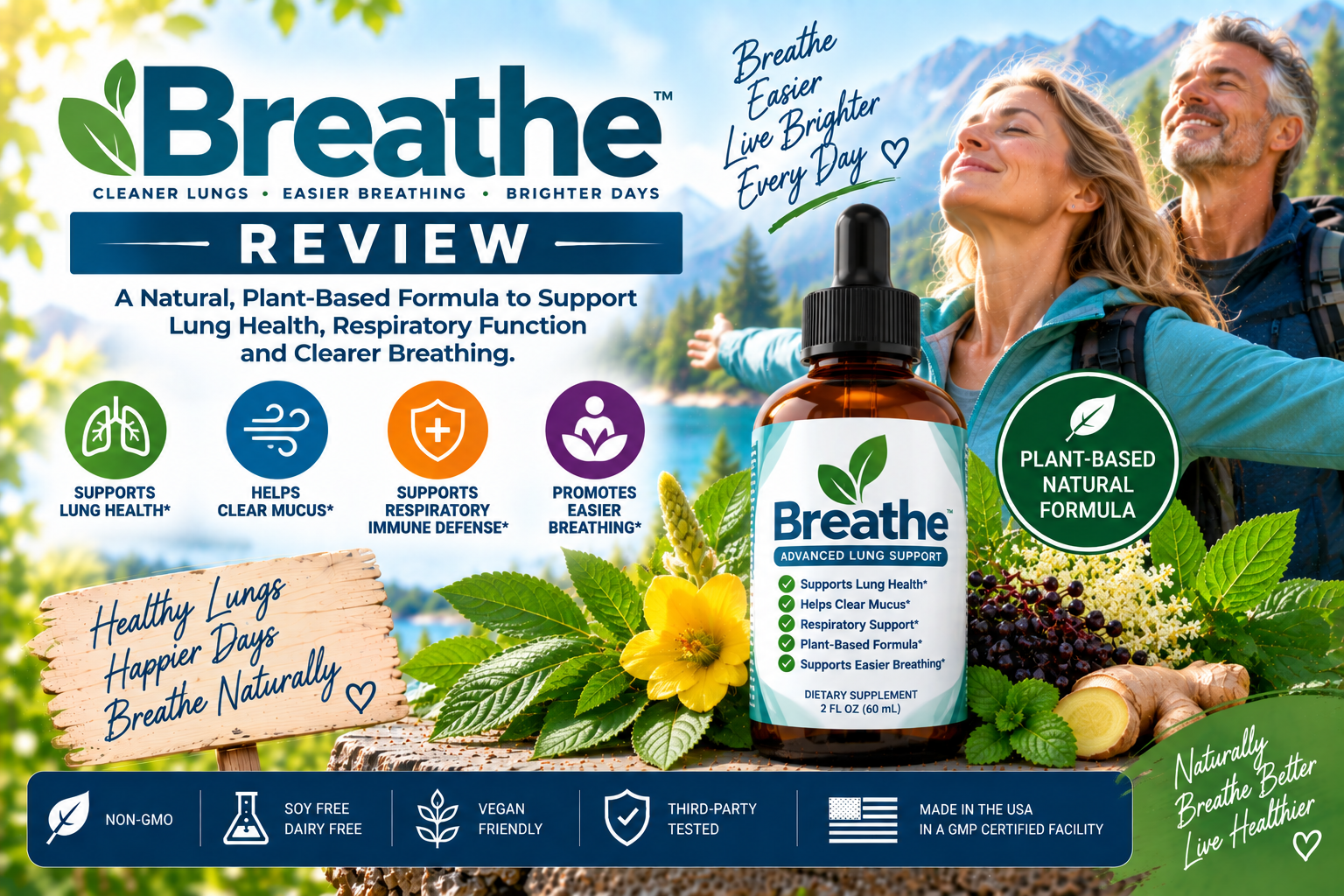
Breathe is a plant-based liquid supplement marketed specifically for lung health, respiratory support, mucus clearance and easier breathing.
Rather than coming as capsules or tablets, Breathe is supplied as concentrated liquid drops.
The manufacturer’s marketing places particular emphasis on what it calls “deep cleansing” for the lungs, claiming its botanical formula helps the body’s natural processes for clearing accumulated mucus while supporting more comfortable breathing.
Botanicals associated with current Breathe product information include respiratory herbs such as Mullein, Elderberry and Peppermint, while current descriptions of the broader botanical formula also reference ingredients such as Plantain Leaf, Marshmallow Root, Lobelia, Cordyceps, Vasaka and Ginger.
There is a genuine history of traditional respiratory use behind several of these herbs.
However, claims that a supplement can literally “detox” the lungs, remove pounds of mucus or eliminate breathlessness require considerable caution.
In this independent Breathe review, we’ll examine the formula, potential benefits, lung-cleansing claims, respiratory-health evidence, safety considerations and limitations.
This review is based on published product information and available ingredient research. We have not personally used or tested Breathe.
What Is Breathe?
Breathe is a liquid herbal supplement designed to support healthy lung function and respiratory wellness.
The main themes throughout the manufacturer’s current website include:
- Lung health
- Respiratory health
- Healthy breathing
- Lung support
- Mucus clearance
- Airway comfort
- Clear breathing
- Respiratory wellness
- Lung cleansing
- Lung detox
- Breathlessness
- Cough and mucus support
- Healthy respiratory function
Breathe differs from many supplements because it is supplied as a liquid botanical formula rather than capsules.
The manufacturer recommends taking it several times throughout the day.
It is marketed primarily toward adults looking for additional nutritional or herbal support for their respiratory system.
The most sensible way to think about Breathe is as a botanical respiratory-support supplement.
It should not be confused with a prescription inhaler, bronchodilator, corticosteroid, antibiotic or other medical treatment.
How Does Breathe Work?
The concept behind Breathe focuses largely on the body’s normal mechanisms for managing respiratory secretions and maintaining comfortable airways.
The lungs already have an impressive self-cleaning system.
Airway surfaces contain mucus that traps particles, while microscopic hair-like structures known as cilia help transport trapped material upward so it can eventually be swallowed or coughed out.
This process is known as mucociliary clearance.
Several herbs traditionally used for respiratory wellness are promoted as helping soothe the throat and airways or supporting normal mucus movement.
Breathe combines these botanical concepts into a liquid formula.
The manufacturer goes considerably further, describing the supplement as a way to “deep cleanse” the lungs and rapidly remove substantial mucus buildup.
That language should be interpreted as marketing.
There isn’t good evidence that healthy lungs contain pounds of stagnant mucus that can simply be flushed out with a herbal supplement.
The more scientifically reasonable description is that Breathe contains botanicals traditionally associated with respiratory comfort, normal mucus clearance and general lung wellness.
Breathe Ingredients
The current Breathe website displays its detailed formulation through a product-label image rather than presenting every ingredient and amount consistently in searchable page text.
For that reason, the physical Supplement Facts label supplied with the product should always be treated as the definitive source for the exact current formula and amounts.
Current Breathe product information and supporting material prominently reference the following respiratory botanicals.
Mullein
Mullein, or Verbascum thapsus, is one of the herbs most closely associated with traditional respiratory remedies.
Its leaves have historically been used in herbal preparations intended to soothe the throat and respiratory tract.
Mullein contains mucilage and various plant compounds that help explain its traditional reputation as a soothing herb.
It is also frequently described as an expectorant in traditional herbalism.
An expectorant is something intended to help make respiratory secretions easier to clear.
However, traditional use isn’t the same as high-quality clinical evidence.
There is currently limited robust human research demonstrating that Mullein supplements significantly improve lung function or treat chronic respiratory disease.
Its inclusion in Breathe therefore makes sense from a traditional respiratory-support perspective, but stronger lung-cleansing claims shouldn’t automatically be attributed to it.
Elderberry
Elderberry, usually derived from Sambucus nigra, is widely used in seasonal wellness supplements.
The dark berries contain anthocyanins and other polyphenols with antioxidant activity.
Elderberry has attracted research interest particularly in relation to upper-respiratory symptoms.
Some studies have suggested potential effects on the duration or severity of certain cold and flu-like symptoms, although the evidence remains inconsistent and depends heavily on the preparation studied.
This does not establish Elderberry as a way to clean mucus from the lungs.
Its more reasonable role within Breathe is antioxidant and general seasonal respiratory support.
Peppermint
Peppermint, or Mentha piperita, contains menthol.
Menthol creates the familiar cooling sensation associated with peppermint.
When inhaled or consumed, this cooling sensation can make breathing feel more open or comfortable.
That sensory effect is important.
Feeling that airflow is easier doesn’t necessarily mean the physical diameter of the airways has increased substantially or lung capacity has improved.
Peppermint therefore contributes naturally to the fresh, cooling respiratory-comfort positioning of Breathe.
It shouldn’t be regarded as a treatment for obstructive lung disease.
Plantain Leaf
Plantain Leaf, generally referring to species such as Plantago lanceolata, has a long history of traditional herbal use for throat and respiratory comfort.
It contains mucilage and other plant compounds that may have soothing properties.
Plantain Leaf is often included in traditional herbal preparations intended to soothe irritated mucous membranes.
Human clinical evidence for major improvements in lung function remains limited.
Its role is therefore better understood as part of the formula’s broader airway-soothing botanical blend.
Marshmallow Root
Marshmallow Root, or Althaea officinalis, is rich in mucilage.
This slippery plant material helps explain why Marshmallow Root has traditionally been used for irritated throats and mucous membranes.
Some people may find mucilaginous herbs soothing when dealing with throat irritation or occasional cough.
However, soothing the throat is different from removing mucus deep within the lungs.
Marshmallow Root should therefore be considered a comfort-support ingredient, rather than evidence that Breathe performs a medical lung cleanse.
Ginger Root
Ginger, or Zingiber officinale, is widely used both as a food and traditional botanical.
It contains compounds including gingerols and shogaols that have been investigated for antioxidant and inflammatory pathways.
Ginger has broad nutritional and traditional-health relevance.
Laboratory findings involving inflammatory processes, however, don’t establish that oral Ginger directly reduces inflammation inside the lungs in people with respiratory disease.
Its inclusion contributes to Breathe’s broader botanical wellness formula.
Cordyceps
Cordyceps is a fungus with a long history of traditional use, particularly in Asian medicine.
It has attracted research interest in areas including exercise performance, oxygen utilization, fatigue and respiratory health.
Some studies involving specific Cordyceps preparations have examined respiratory and exercise-related outcomes.
Results vary substantially according to the population and extract used.
This makes Cordyceps an interesting ingredient for a supplement targeting breathing, stamina and respiratory wellness, but it doesn’t establish that Breathe improves oxygen saturation or lung capacity.
Vasaka
Vasaka, also known as Adhatoda vasica or Justicia adhatoda, has a long history of traditional use for respiratory complaints.
It contains alkaloids including vasicine.
Traditional preparations have been associated with cough and mucus support.
Modern research has investigated these compounds for several respiratory mechanisms, but evidence for commercially available supplements remains much less established than traditional claims sometimes imply.
Vasaka should therefore be viewed as another traditional respiratory botanical, rather than a proven treatment for lung disease.
Lobelia
Lobelia deserves more caution.
Lobelia inflata has historically been used in traditional respiratory preparations and contains the alkaloid lobeline.
However, Lobelia can produce adverse effects at inappropriate doses, including nausea, vomiting, dizziness and cardiovascular effects.
This makes dosage particularly important.
People with medical conditions, those taking medication, and pregnant or breastfeeding women should obtain professional advice before using a formula containing Lobelia.
The exact current physical Breathe label should be checked before use.
Potential Benefits of Breathe
1. May Support Healthy Lung Function
Breathe is primarily marketed as a lung support supplement.
Its collection of traditional respiratory botanicals provides a plausible herbal basis for general lung and airway wellness.
However, “supporting healthy lung function” is considerably different from improving medically measured lung capacity.
No finished-product evidence should be assumed unless supported by appropriate clinical testing.
2. May Support Normal Mucus Clearance
This is one of Breathe’s biggest marketing themes.
The respiratory system naturally produces mucus to trap inhaled particles and microorganisms.
Cilia then help move that mucus toward the throat.
Certain traditional herbs in Breathe are associated with expectorant or soothing effects and may complement normal respiratory comfort.
But mucus isn’t inherently bad.
Healthy lungs require an appropriate mucus layer.
The objective isn’t to eliminate all mucus but to maintain normal respiratory clearance.
3. May Support Comfortable Breathing
Peppermint’s menthol content can create a noticeable sensation of cool, open breathing.
Mucilaginous herbs such as Marshmallow Root and Plantain Leaf may also help soothe irritated throat tissues.
Together, these effects provide a reasonable rationale for breathing comfort.
They don’t establish that the supplement opens constricted airways in the same way as prescription bronchodilator medication.
4. May Provide Seasonal Respiratory Support
Elderberry and several of the formula’s botanicals are commonly used in seasonal wellness products.
That may make Breathe particularly interesting to adults who find their respiratory comfort changes during colder months or periods of seasonal irritation.
However, supplements shouldn’t be assumed to prevent respiratory infections.
5. Provides Antioxidant Plant Compounds
Elderberry, Ginger and several other botanicals contain antioxidant compounds.
Antioxidants help protect cells against oxidative stress.
This contributes to the overall nutritional rationale of the formula.
Antioxidant activity in a laboratory, however, doesn’t prove that Breathe repairs damaged lungs.
6. May Complement Long-Term Respiratory Wellness
For someone primarily interested in maintaining healthy lungs and comfortable breathing, Breathe may complement broader lifestyle measures.
Those measures—especially avoiding smoking and minimizing exposure to airborne irritants—remain considerably more important than any supplement.
Does Breathe Really Cleanse the Lungs?
The phrase “lung cleanse” is one of the biggest SEO and marketing themes surrounding Breathe.
It also requires careful explanation.
The lungs don’t normally need a supplement to “detox” them.
Healthy lungs continuously clear particles through mucus, cilia, coughing and immune mechanisms.
The liver and kidneys also perform major roles in processing and eliminating substances from the body.
There is no established clinical process whereby a herbal tincture washes toxins out of lung tissue.
Some botanical ingredients may potentially support normal respiratory comfort or mucus movement.
That is much more plausible than describing Breathe as literally detoxifying the lungs.
Can Breathe Clear Mucus From the Lungs?
The manufacturer makes particularly strong claims about excess lung mucus.
Some herbs traditionally categorized as expectorants may help make respiratory secretions easier to manage.
But persistent or excessive mucus can have many causes, including:
- Respiratory infection
- Smoking
- Asthma
- COPD
- Bronchiectasis
- Allergies
- Reflux
- Environmental irritation
A supplement shouldn’t be used to assume the underlying cause.
The website’s particularly dramatic suggestion that someone can clear 2.6 pounds of excess lung mucus shouldn’t be interpreted as an established or typical physiological outcome.
Breathe and Shortness of Breath
Shortness of breath or breathlessness deserves special caution.
Breathe is marketed heavily around easier breathing.
But breathlessness can occur because of respiratory, cardiovascular, metabolic and other medical problems.
Potential causes range from asthma and COPD to anaemia, heart disease, infections and blood clots.
A botanical supplement is not an appropriate substitute for evaluating unexplained or worsening breathlessness.
Sudden or severe difficulty breathing requires urgent medical attention.
Breathe for Smokers and Former Smokers
People who smoke or previously smoked may understandably be interested in lung cleansing supplements.
Stopping smoking is by far the most important step.
After smoking cessation, the respiratory system can gradually recover some normal function, and ciliary activity can improve over time.
No supplement has been proven to remove accumulated tobacco damage from the lungs.
Breathe may potentially provide general botanical respiratory support, but it shouldn’t be portrayed as reversing smoking-related lung damage.
Former or current smokers experiencing persistent cough, breathlessness, wheezing or coughing up blood should seek appropriate medical assessment.
Breathe for COPD
The Breathe website contains marketing and testimonials that may attract people living with COPD.
This requires particularly careful wording.
Breathe is not a treatment for COPD.
COPD is a chronic lung disease involving persistent airflow limitation.
Evidence-based management may involve inhalers, pulmonary rehabilitation, vaccinations, smoking cessation, exercise and other medical treatments.
Someone diagnosed with COPD should never replace prescribed treatment with Breathe or another supplement.
A respiratory supplement can at most be considered complementary after discussing it with the relevant healthcare professional.
Breathe for Asthma
The same principle applies to asthma.
Asthma involves airway inflammation and variable narrowing of the airways.
A cooling sensation from Peppermint isn’t equivalent to medically reversing bronchoconstriction.
Breathe isn’t a rescue inhaler.
Anyone experiencing an asthma attack should follow their established asthma action plan and use prescribed rescue medication as directed.
Breathe for Cough
Some Breathe ingredients have traditional associations with cough and throat comfort.
Mullein, Marshmallow Root and Plantain Leaf are particularly relevant to traditional herbal preparations for irritated throats.
That could make the formula appealing for occasional respiratory comfort.
However, persistent cough deserves investigation.
A cough lasting several weeks, recurring frequently or accompanied by breathlessness, fever, chest pain or blood shouldn’t simply be suppressed with supplements.
Does Breathe Improve Lung Capacity?
There isn’t sufficient evidence to say the complete Breathe supplement meaningfully increases measured lung capacity.
Some ingredients, including Cordyceps, have been investigated for exercise and respiratory performance.
Those studies cannot automatically be applied to the finished Breathe formula.
Claims of improved lung capacity should ideally be demonstrated using objective measurements such as spirometry.
Feeling that breathing is more comfortable isn’t the same as demonstrating increased pulmonary function.
Does Breathe Increase Oxygen Levels?
The manufacturer associates better breathing with improved oxygen delivery and energy.
That sounds intuitive, but it shouldn’t be assumed that Breathe increases blood oxygen saturation.
Most healthy people already maintain tightly regulated oxygen saturation.
Persistently low oxygen levels can indicate a significant medical problem.
Anyone measuring unexpectedly low oxygen saturation should seek appropriate medical advice rather than attempting to correct it with a supplement.
Breathe and Lung Detoxification
“Lung detox” is a popular wellness phrase, but it isn’t a clearly defined medical process.
Avoiding harmful exposures is far more important than trying to detoxify the lungs afterwards.
Practical steps include:
- Not smoking
- Avoiding second-hand smoke
- Reducing exposure to dust and fumes
- Using appropriate workplace respiratory protection
- Maintaining indoor air quality
- Exercising regularly where medically appropriate
Breathe may complement general respiratory wellness.
It shouldn’t be considered a substitute for reducing the source of lung irritation.
How Do You Take Breathe?
According to the current manufacturer’s FAQ, the recommended use is:
Take 2–3 ml or 1–3 drops of Breathe, two to three times per day.
There is an obvious inconsistency in that wording because 2–3 ml and 1–3 individual drops are very different volumes.
For that reason, consumers should follow the dosage printed on the current physical bottle and seek clarification from the manufacturer if the label is unclear.
The current website describes one bottle as approximately a 30-day supply.
How Long Does Breathe Take to Work?
The manufacturer says results vary.
Its current website states that some customers report changes immediately, while recommending approximately three to six months of use for the best chance of seeing results.
Those are manufacturer statements rather than an independently established clinical timeline.
Traditional herbal supplements often don’t produce an obvious immediate effect.
More importantly, anyone experiencing significant respiratory symptoms shouldn’t wait months to see whether a supplement solves the problem.
Is Breathe Natural?
According to the manufacturer, Breathe is a natural proprietary formula.
The current website describes it as:
- 100% plant-based
- Soy-free
- Dairy-free
- Non-GMO
The manufacturer also states that Breathe is produced in the USA in an FDA-registered and GMP-certified facility and that ingredients undergo additional third-party inspections and quality-control procedures.
These are manufacturing claims rather than evidence that the supplement treats respiratory disease.
An FDA-registered manufacturing facility also does not mean Breathe is FDA-approved as a treatment.
Is Breathe Safe?
Natural botanical formulas can still produce side effects and medication interactions.
This is particularly important with a multi-ingredient respiratory tincture.
Safety can depend on:
- Exact ingredients
- Dosages
- Existing medications
- Medical conditions
- Allergies
- Pregnancy or breastfeeding
- Duration of use
Lobelia warrants particular caution because inappropriate amounts can cause adverse effects.
People using prescription medication or managing a respiratory condition should show the complete current Breathe label to their healthcare professional before taking it.
The manufacturer itself recommends doing this.
Breathe Side Effects
Potential effects from a multi-botanical formula can include:
- Digestive discomfort
- Nausea
- Diarrhoea
- Headache
- Dizziness
- Allergic reactions
- Throat or mouth irritation
- Medication interactions
The actual risk depends on the current formulation and amounts.
Anyone experiencing a significant reaction should stop taking the product and seek appropriate advice.
Limitations of Breathe
“Lung Cleansing” Is an Oversimplification
The lungs already possess sophisticated mechanisms for removing inhaled material.
Breathe may provide botanical respiratory support, but it hasn’t been established as a literal lung-cleaning treatment.
The Mucus Claims Are Too Strong
Claims about removing pounds of mucus shouldn’t be regarded as typical or clinically established outcomes.
Persistent excessive mucus may indicate an underlying condition requiring evaluation.
Ingredient Research Is Not Product Research
Individual Breathe ingredients have traditional use and varying degrees of scientific research.
That doesn’t demonstrate that the complete commercial formula produces the same outcomes.
Testimonials Don’t Establish Effectiveness
The website contains positive customer stories involving cough, mucus and breathing.
Those experiences may be genuine, but testimonials cannot determine average effectiveness or prove causation.
Respiratory Symptoms Can Be Medically Important
Cough, wheezing and breathlessness shouldn’t automatically be interpreted as signs that the lungs need “detoxing.”
They can be symptoms of medical conditions requiring diagnosis and treatment.
Breathe Money-Back Guarantee
The current Breathe website prominently advertises a 180-day, 100% money-back guarantee.
It also describes purchases as one-time payments with no autoship, subscriptions or hidden charges.
There is, however, inconsistent wording within the current FAQ.
One section refers to a 180-day guarantee but also says customers have 90 days to request a refund, while another section describes the full 180-day guarantee.
Because of that inconsistency, buyers should carefully check the refund terms applying to their specific order before purchasing.
Who Might Consider Breathe?
Breathe may appeal to adults who:
- Want additional respiratory support
- Are interested in lung-health supplements
- Prefer a liquid herbal tincture
- Are interested in Mullein
- Want traditional respiratory botanicals
- Want support for normal mucus clearance
- Are interested in airway comfort
- Prefer plant-based ingredients
- Want stimulant-free respiratory wellness support
- Understand that “lung detox” claims have significant limitations
It is not an appropriate substitute for medical treatment in someone experiencing significant respiratory symptoms.
Supporting Lung Health Naturally
Several approaches have substantially stronger evidence for protecting long-term lung health than any supplement.
The most important is avoiding tobacco smoke.
For people who currently smoke, quitting can provide enormous benefits at almost any age.
Regular physical activity can also improve cardiovascular fitness and make everyday physical activity feel easier.
Additional useful habits include staying appropriately hydrated, maintaining a balanced diet, reducing exposure to airborne pollutants, using protective equipment around occupational dust and fumes, maintaining recommended vaccinations and managing diagnosed respiratory conditions appropriately.
Breathing exercises and pulmonary rehabilitation can also be valuable in specific circumstances when professionally recommended.
When Breathing Problems Need Medical Attention
Respiratory symptoms sometimes require prompt assessment.
Seek appropriate medical attention for:
- New or worsening shortness of breath
- Significant wheezing
- Chest pain
- Coughing up blood
- Blue or grey lips or skin
- Confusion
- Persistently low oxygen saturation
- High fever with breathing difficulty
- A persistent unexplained cough
- Unexplained weight loss associated with respiratory symptoms
Sudden severe difficulty breathing can be a medical emergency.
A supplement shouldn’t delay urgent care.
Final Verdict: Is Breathe Worth Trying?
Breathe is a liquid plant-based supplement designed around lung health, respiratory wellness, breathing comfort and normal mucus clearance.
Its botanical approach is interesting.
Current Breathe information centers on traditional respiratory ingredients such as Mullein, Elderberry and Peppermint, alongside a wider botanical blend associated with airway comfort and respiratory wellness.
There is genuine traditional use behind several of these ingredients.
Mullein has a long history in respiratory herbalism.
Peppermint’s menthol can create a cooling sensation that may make breathing feel more comfortable.
Elderberry contains antioxidant polyphenols and has been investigated in seasonal respiratory research.
Other traditional botanicals provide additional rationale for throat and airway comfort.
Where Breathe becomes considerably less convincing is its aggressive lung-cleansing marketing.
Claims that people carry pounds of excess mucus in their lungs, that a herbal formula can perform a deep lung detox or that it can eliminate breathlessness shouldn’t be treated as established clinical outcomes.
We also did not identify evidence establishing Breathe as a treatment for COPD, asthma, chronic bronchitis or another diagnosed lung disease.
That distinction is extremely important.
Overall, Breathe is best viewed as an optional botanical respiratory-health supplement that may support normal mucus clearance, airway comfort and healthy breathing.
It isn’t a prescription respiratory treatment, emergency medication or proven method for reversing lung damage.
The manufacturer’s plant-based positioning, liquid format and current 180-day advertised guarantee may make it interesting to adults looking for additional respiratory wellness support.
But persistent cough, wheezing, breathlessness or excessive mucus deserves proper medical evaluation rather than simply being interpreted as a sign that the lungs need cleansing.
Realistic expectations are particularly important with this product.
👉 To learn more please click here to visit the product website.
Leave a Reply
You must be logged in to post a comment.