The relationship between gut health, the gut microbiome and weight management has become an increasingly important area of scientific research.
The trillions of microorganisms living within the digestive system can influence digestion, metabolism, immune function and the production of numerous biologically active compounds. Researchers are also investigating whether differences in the gut microbiome may help explain why some people find maintaining a healthy weight more difficult than others.
This research provides the central idea behind Lean Biome, currently branded as Biome® by Lean for Good.
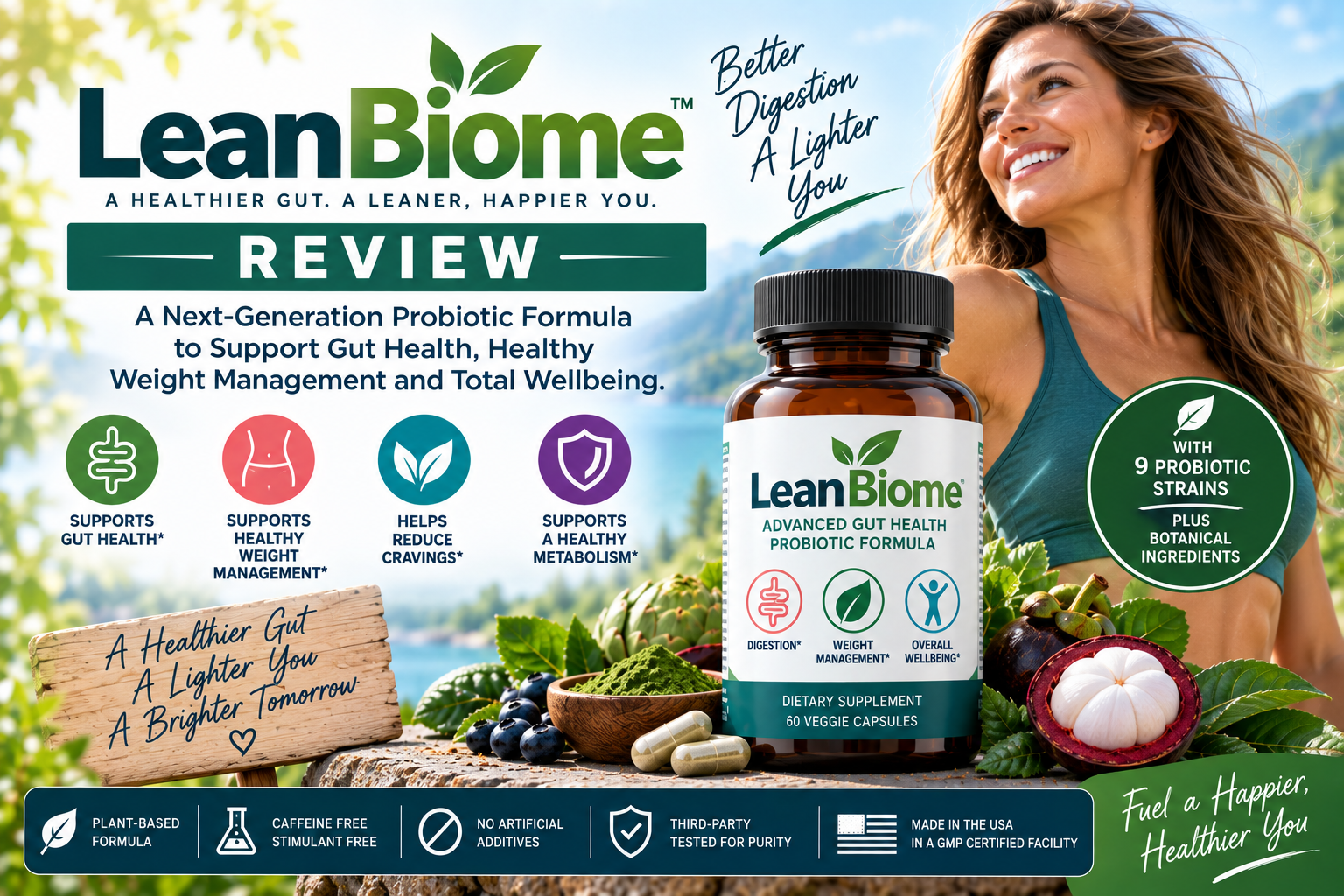
Biome is a probiotic-based weight management supplement combining nine selected bacterial strains with Greenselect Phytosome®, a patented caffeine-free green tea extract. The current formula also includes additional ingredients designed to complement the probiotic blend.
According to the manufacturer, the formula is designed to promote a healthier, more diverse gut microbiome while supporting healthy metabolism, appetite control, reduced cravings and healthy weight management.
But does the science support these claims?
In this independent Lean Biome review, we’ll examine the ingredients, gut-health concept, potential weight-management benefits, limitations and safety considerations to determine whether Biome offers a reasonable approach to supporting a healthy gut microbiome and healthy weight.
This review is based on published product information and ingredient research. It does not imply that we have personally used or tested Lean Biome/Biome.
What Is Lean Biome?
Lean Biome, or Biome®, is a doctor-formulated dietary supplement marketed primarily for weight loss and gut microbiome support.
Rather than approaching weight management with stimulants, Biome focuses on the relationship between intestinal bacteria and metabolic health.
The manufacturer describes the formula as combining nine clinically researched bacterial strains with Greenselect Phytosome®, a caffeine-free green tea extract formulated using Phytosome® delivery technology.
The current formula also incorporates additional ingredients including Inulin, Sphaeranthus indicus and Garcinia mangostana.
Biome is therefore designed around several interconnected wellness goals:
- Supporting a healthy gut microbiome
- Supporting healthy weight management
- Maintaining healthy metabolism
- Supporting digestive health
- Helping manage appetite and cravings
- Supporting healthy body composition
- Supporting long-term metabolic wellness
The concept is certainly more interesting than simply adding caffeine to another conventional fat-burning supplement.
However, some of the manufacturer’s explanations of the microbiome and weight gain require considerably more context.
How Does Lean Biome Work?
The central theory behind Biome is that the composition of the gut microbiome can influence body weight and metabolic health.
There is legitimate science behind this general idea.
Researchers have found associations between gut microbial composition, obesity, diet and metabolic health.
Gut microorganisms can influence energy extraction from food, production of short-chain fatty acids, intestinal signalling and interactions with appetite and metabolic pathways.
Where the marketing becomes more speculative is the idea that people can be neatly divided into those with “lean bacteria” and those dominated by “fat bacteria.”
Human obesity is much more complicated.
Genetics, total calorie intake, food environment, physical activity, sleep, medications, socioeconomic factors, hormones, medical conditions and many other variables can contribute to body weight.
The microbiome may be another important piece of that puzzle, but it shouldn’t currently be regarded as the single universal root cause of belly fat or unexplained weight gain.
Biome attempts to influence this area by supplying selected probiotic organisms alongside ingredients intended to complement gut and metabolic health.
Lean Biome Ingredients
Lactobacillus Gasseri
Lactobacillus gasseri is one of the most heavily promoted probiotic strains within Biome.
It has attracted research interest because certain strains have been investigated for effects involving body weight, abdominal fat and metabolic health.
The manufacturer highlights a 12-week study involving overweight adults in which a fermented milk product containing a particular L. gasseri strain was associated with reductions in abdominal visceral and subcutaneous fat.
This research is interesting.
However, probiotic effects can be highly strain-specific.
A clinical result involving one particular L. gasseri strain, dosage and food matrix cannot automatically be assumed to apply identically to every supplement containing the species.
Nevertheless, L. gasseri is one of the more relevant ingredients in a probiotic formula targeting gut health and healthy weight management.
Lactobacillus Rhamnosus
Lactobacillus rhamnosus is another widely researched probiotic species.
The Biome website highlights research involving overweight women following a calorie-restricted weight-loss programme.
Certain studies have suggested that specific L. rhamnosus preparations may influence weight loss or weight maintenance under particular conditions.
Again, the important word is specific.
Probiotics aren’t interchangeable simply because they share a species name.
Still, its inclusion provides another reasonable ingredient-level rationale for Biome’s focus on the microbiome and weight.
Lactobacillus Fermentum
Lactobacillus fermentum is another member of the manufacturer’s nine-strain probiotic blend.
The official website cites research associating particular probiotic preparations with changes in body composition.
Like the other organisms in the formula, L. fermentum may also interact with the intestinal environment and broader digestive function.
Research in this area remains developing, and the magnitude of weight-related effects seen with probiotics is generally much more modest and variable than supplement advertising can imply.
Additional Probiotic Strains
Biome contains a total of nine bacterial strains, which the manufacturer collectively describes as its proprietary “Lean Bacteria” blend.
The idea is to provide multiple microorganisms rather than depending entirely on one probiotic.
Multi-strain probiotic formulations may potentially influence the intestinal environment through several mechanisms.
However, having more strains doesn’t automatically make a probiotic more effective.
Clinical usefulness depends on the identity of the strains, their dose, viability and whether they have evidence for the particular outcome being targeted.
Greenselect Phytosome®
One of the most distinctive ingredients in Biome is Greenselect Phytosome®.
This is a patented, caffeine-free green tea extract formulated with Phytosome technology.
Green tea contains polyphenols known as catechins, including EGCG, that have been extensively investigated for their potential effects on metabolism and weight management.
The manufacturer highlights a controlled study involving overweight adults following a calorie-controlled diet.
Participants receiving Greenselect Phytosome alongside that diet reportedly experienced greater weight reduction than the diet-only group.
That is potentially relevant evidence.
But there is an important distinction between demonstrating benefits from a particular ingredient alongside a calorie-controlled diet and demonstrating that Biome itself produces effortless weight loss without dietary changes.
The latter claim requires considerably stronger product-specific evidence.
Another useful feature is that the Greenselect Phytosome used in Biome is described by the manufacturer as caffeine-free, meaning Biome doesn’t rely on stimulant-driven energy expenditure.
Inulin
The current Biome formula also contains Inulin.
Inulin is a fermentable dietary fibre found naturally in numerous plants.
It is widely used as a prebiotic because certain beneficial intestinal microorganisms can ferment it.
This makes Inulin a particularly logical addition to a probiotic formula.
Rather than introducing microorganisms alone, the combination of probiotics and prebiotic fibre aims to provide an environment in which beneficial bacteria can potentially thrive.
Inulin can, however, produce bloating, gas or digestive discomfort in some people, particularly when consumed in larger quantities or when someone isn’t accustomed to fermentable fibres.
Sphaeranthus Indicus
Sphaeranthus indicus is a flowering plant native to parts of Asia.
The current Biome website says it was added as part of an updated formulation, particularly in combination with Garcinia mangostana.
Extracts of these plants have been investigated together in clinical studies involving body composition and weight management.
This makes the ingredient relevant to the product’s overall positioning.
However, evidence involving a particular standardized botanical combination doesn’t necessarily establish the same effect from every formulation containing the plant.
Garcinia Mangostana
Garcinia mangostana, better known as mangosteen, is a tropical fruit containing various plant compounds including xanthones.
Biome combines Garcinia mangostana with Sphaeranthus indicus as an additional botanical component targeting healthy weight management and body composition.
Some human research has investigated standardized combinations containing these two botanical extracts.
The evidence is interesting but much less extensive than the marketing surrounding mainstream weight-loss products can sometimes suggest.
These ingredients are therefore better considered complementary components rather than proven fat-loss solutions.
What Is the Gut Microbiome?
The gut microbiome refers to the enormous community of bacteria, fungi, viruses and other microorganisms living primarily within the large intestine.
These organisms aren’t simply passive passengers.
They interact with dietary fibre, produce metabolites, influence immune function and communicate with numerous physiological systems.
Diet has an especially important influence on the microbiome.
A varied diet rich in vegetables, fruits, legumes, whole grains and other fibre-rich plant foods generally provides substrates that support diverse microbial communities.
This explains why probiotics are most sensibly viewed as one component of gut health rather than a substitute for good nutrition.
Can Gut Bacteria Affect Weight?
Potentially, yes.
Research increasingly indicates relationships between gut bacteria, obesity and metabolic health.
Animal experiments have provided particularly compelling demonstrations that transferring certain microbial communities can influence body composition.
Human research has also identified differences between microbial communities in lean and overweight populations.
But association doesn’t always establish simple cause and effect.
Someone’s diet can influence their microbiome while simultaneously influencing their body weight.
This creates a complex two-way relationship.
For this reason, claims that an imbalanced microbiome is the root cause of weight gain go further than current evidence supports.
The microbiome is better understood as one potential contributor within a much larger metabolic system.
Potential Benefits of Lean Biome
1. May Support a Healthy Gut Microbiome
The most straightforward potential benefit of Biome is gut microbiome support.
The formula combines multiple probiotic strains with Inulin, a prebiotic fibre.
This provides a reasonable nutritional strategy for influencing the intestinal microbial environment.
Whether that produces a noticeable benefit will vary considerably between individuals because everyone’s microbiome is different.
2. May Support Healthy Weight Management
Several ingredients have been individually investigated for weight management.
Particular strains of L. gasseri and L. rhamnosus have attracted research interest, while Greenselect Phytosome and the Sphaeranthus/Garcinia combination have also been studied in weight-related contexts.
This gives Biome a more interesting evidence base than a supplement assembled from completely unstudied ingredients.
The crucial limitation is that research on individual ingredients doesn’t establish that the finished Biome supplement will produce the same magnitude of weight loss.
3. May Support Healthy Metabolism
The official website promotes healthy metabolism as another major benefit.
Gut microorganisms produce compounds that interact with metabolic signalling, while green tea polyphenols have also been investigated for metabolic effects.
This provides a reasonable rationale for general metabolic support.
But “supporting metabolism” shouldn’t be interpreted as dramatically accelerating calorie burning.
4. May Help Support Appetite Control
The manufacturer frequently discusses hunger and appetite.
The gastrointestinal tract communicates extensively with the brain through hormones, nerves and microbial metabolites.
This gut-brain relationship is genuinely relevant to appetite regulation.
However, evidence that Biome consistently suppresses hunger enough to produce major effortless weight loss remains limited.
Any appetite changes should be regarded as a possible individual response rather than a guaranteed outcome.
5. May Help With Food Cravings
Cravings are another recurring theme in Biome’s marketing.
Gut-brain signalling is an interesting research area, and changes in dietary habits or microbiome composition could potentially influence food preferences.
But cravings are influenced by many factors including sleep, stress, habits, food availability and calorie restriction.
Biome shouldn’t therefore be viewed as a guaranteed way of eliminating sugar or carbohydrate cravings.
6. May Support Digestive Health
Probiotic and prebiotic ingredients can also have relevance beyond weight management.
They may influence digestive health, stool characteristics and intestinal microbial balance.
Inulin provides fermentable fibre, while the probiotic strains add microorganisms intended to complement the gut ecosystem.
Some users may initially experience increased gas or bloating as their digestive system adapts to fermentable ingredients.
7. Provides Weight-Management Support Without Stimulants
Many conventional fat-burning supplements rely heavily on caffeine.
Biome takes a different approach.
According to the manufacturer, its Greenselect Phytosome ingredient is caffeine-free, and the finished formula is stimulant-free.
This may make it more appealing to people who are sensitive to caffeine or don’t want another stimulant in their daily routine.
Can Lean Biome Reduce Belly Fat?
The official marketing places considerable emphasis on belly fat and visceral fat.
Some individual probiotic studies have reported changes in abdominal fat measures, which provides a scientific reason for interest.
But consumers should keep the magnitude of those effects in perspective.
No probiotic can selectively command the body to burn fat exclusively from the abdomen.
Long-term reduction in belly fat generally accompanies overall fat loss produced through sustained changes in energy balance.
Biome may potentially complement this process, but it shouldn’t be regarded as a substitute for it.
Does Lean Biome Boost Metabolism?
The answer depends on what is meant by “boost.”
Green tea extracts can have measurable metabolic effects, and the gut microbiome is involved in numerous metabolic pathways.
That makes metabolic support reasonable terminology.
But claims that Biome will dramatically “fire up” a previously frozen metabolism should be interpreted as advertising language.
Human metabolism doesn’t normally become switched off because someone lacks a particular probiotic strain.
Does Lean Biome Suppress Hunger and Cravings?
Possibly for some people, but it shouldn’t be guaranteed.
Gut microorganisms can influence compounds involved in appetite signalling, while improved dietary patterns and fibre intake can also increase satiety.
Inulin itself is a dietary fibre.
However, there isn’t sufficient evidence to conclude that everyone taking Biome will experience a substantial reduction in hunger.
Appetite is influenced by an extensive network of hormones, neurological signals, habits and environmental factors.
Is Lean Biome a Probiotic?
Yes.
Biome is fundamentally a multi-strain probiotic weight-management supplement, although its formulation goes beyond probiotics alone.
It combines:
Probiotics – nine bacterial strains.
Prebiotic support – Inulin.
Green tea polyphenols – Greenselect Phytosome.
Botanical weight-management ingredients – Sphaeranthus indicus and Garcinia mangostana.
This combination makes the product better described as a probiotic and metabolic-support formula than as a simple probiotic.
What Are DRcaps®?
Biome uses patented DRcaps® delayed-release capsules.
According to the manufacturer, these capsules are designed to resist immediate breakdown in stomach acid so that more of the probiotic organisms can reach the intestinal environment.
This is relevant because probiotics need to remain viable if they’re intended to colonise or temporarily interact with the gastrointestinal tract.
The manufacturer says disintegration of its DRcaps begins considerably later than conventional immediate-release capsules.
Delayed-release technology is therefore one of the more practical features of the product rather than merely a marketing concept.
How Do You Take Lean Biome?
The current Biome FAQ recommends two capsules per day.
Each bottle contains 60 capsules, providing approximately a 30-day supply.
There is a slight inconsistency between official pages concerning timing.
One current page recommends taking two capsules with food, preferably with breakfast, while another says to take them with water before breakfast.
For this reason, the safest practical approach is to follow the directions printed on the current bottle received with the order.
Biome doesn’t require refrigeration, although the manufacturer recommends keeping bottles in a cool, dry location.
How Long Does Lean Biome Take to Work?
There is no guaranteed timetable.
The manufacturer encourages longer-term use and points to ingredient studies lasting several weeks or months.
Changes in the gut microbiome and body composition aren’t normally instantaneous.
Someone evaluating Biome should therefore be skeptical of claims promising dramatic overnight fat loss.
Weight trends are more meaningfully assessed over weeks and months rather than day-to-day fluctuations in water and digestive contents.
Is Lean Biome Safe?
Biome is described by the manufacturer as caffeine-free and stimulant-free.
The company also states that the formula is vegan-friendly and free from gluten, sugar, nuts, soy, crustaceans and dairy.
It is also marketed as free from GMOs and BPA.
The manufacturer says Biome is produced in the United States in an FDA-inspected, cGMP facility and is independently third-party tested.
These are useful quality considerations, but they don’t guarantee that every individual will tolerate the formula.
Probiotic and prebiotic supplements can produce temporary digestive effects including:
- Gas
- Bloating
- Changes in bowel habits
- Abdominal discomfort
Inulin can be particularly noticeable for people sensitive to fermentable carbohydrates.
People who are pregnant or breastfeeding, take medication, have significant medical conditions or are immunocompromised should discuss supplementation with an appropriate healthcare professional.
Limitations and Considerations
The “Root Cause of Weight Gain” Claim Is Too Simplistic
The biggest issue with Biome’s marketing is the suggestion that an imbalanced microbiome represents the newly discovered root cause of weight gain.
The microbiome is undoubtedly relevant to metabolic research.
But obesity is multifactorial.
Genetics, diet, energy intake, physical activity, sleep, medication, hormones, medical conditions and numerous environmental factors can all influence body weight.
The microbiome may contribute without being the single underlying cause.
Ingredient Studies Are Not Biome Studies
Biome’s marketing cites numerous clinical studies involving individual probiotic strains and botanical ingredients.
That’s useful when assessing whether a formula has a plausible rationale.
It isn’t equivalent to conducting a randomized placebo-controlled trial of the complete Biome formula.
This distinction becomes particularly important when the marketing extrapolates impressive results from separate studies into expectations for the finished product.
Probiotic Effects Are Strain-Specific
The science of probiotics is more precise than simply saying Lactobacillus is beneficial.
Different strains belonging to the same species can behave differently.
Dosage, viability and delivery method matter too.
Consumers should therefore avoid assuming that every study mentioning L. gasseri or L. rhamnosus automatically proves Biome will produce the same outcome.
Weight Loss Still Requires Realistic Expectations
A supplement may support a weight-management programme.
It cannot eliminate the basic importance of diet, activity and overall energy balance.
Even if Biome improves appetite control or metabolic health, sustainable weight management still depends on broader lifestyle patterns.
Lean Biome Money-Back Guarantee
The manufacturer currently provides a 180-day “empty bottle” money-back guarantee.
According to the official policy, customers have six months to evaluate Biome and can request a refund if they’re dissatisfied.
The company specifically states that the guarantee can still apply even if the bottles have been used.
This is a comparatively generous policy for a dietary supplement.
Consumers should still check the latest return conditions before purchasing because shipping, return and refund terms can change.
Who Might Consider Lean Biome?
Lean Biome/Biome may appeal to adults who:
- Want additional gut microbiome support
- Are interested in probiotics for healthy weight management
- Want to support healthy metabolism
- Prefer a stimulant-free weight-management supplement
- Are interested in L. gasseri and other researched probiotics
- Want probiotic and prebiotic ingredients in one formula
- Are interested in green tea polyphenols without caffeine
- Want support alongside a healthy weight-loss programme
- Understand that probiotics aren’t a replacement for diet and physical activity
It is less appropriate for someone expecting a probiotic to produce effortless or guaranteed rapid fat loss without wider lifestyle changes.
Lean Biome vs a Standard Probiotic
A standard probiotic is generally designed primarily around digestive or microbiome support.
Biome takes a broader approach.
Its nine probiotic strains are combined with Greenselect Phytosome, Inulin, Sphaeranthus indicus and Garcinia mangostana.
That means the formula targets both gut health and weight management.
The delayed-release DRcaps technology is another practical difference.
Someone looking purely for digestive support may not need all of these additional ingredients.
But for someone specifically interested in the emerging relationship between the gut microbiome and healthy body weight, Biome offers a more targeted formulation.
Supporting a Healthy Gut Microbiome Naturally
Supplements aren’t the only—or necessarily the most important—way of supporting the microbiome.
Diet has an enormous influence.
Eating a broad variety of plant foods provides different fibres and polyphenols that intestinal microorganisms can metabolise.
Vegetables, fruits, legumes, whole grains, nuts and seeds can all contribute.
Fermented foods such as yoghurt, kefir, sauerkraut and kimchi may also provide beneficial microorganisms or fermentation products.
Exercise, adequate sleep and avoiding unnecessary antibiotic use can further contribute to overall gut and metabolic health.
Biome is therefore best considered an optional addition to these fundamentals.
Lean Biome and Long-Term Weight Management
Successful weight management generally depends on habits that can be sustained.
Protein and fibre-rich foods can improve satiety, while resistance training and physical activity help maintain lean body mass and energy expenditure.
Sleep also matters because insufficient sleep can influence appetite and food choices.
A probiotic supplement might complement these behaviours.
It shouldn’t become a reason to ignore them.
The most realistic role for Biome is therefore as a supportive gut-health and weight-management supplement, rather than the primary driver of someone’s weight-loss strategy.
Final Verdict: Is Lean Biome Worth Trying?
Lean Biome, currently sold as Biome® by Lean for Good, is an interesting probiotic-based supplement targeting the relationship between gut health, the gut microbiome and healthy weight management.
The formula combines nine probiotic strains with Greenselect Phytosome®, a patented caffeine-free green tea extract, alongside additional ingredients including Inulin, Sphaeranthus indicus and Garcinia mangostana.
There is legitimate science behind several aspects of this approach.
Specific strains of L. gasseri and L. rhamnosus have been investigated in weight-management research. Green tea polyphenols have an established history of metabolic research, and Inulin is a well-known prebiotic fibre.
The delayed-release DRcaps technology also makes practical sense for a product containing live microorganisms.
The biggest weakness isn’t necessarily the formulation—it is the strength of some of the marketing surrounding it.
Claims that an imbalanced microbiome is the root cause of belly fat and unexplained weight gain dramatically simplify the biology of obesity.
Likewise, results from separate clinical trials involving individual ingredients shouldn’t be combined to imply that everyone taking Biome will experience similarly dramatic fat loss.
For adults interested in probiotics, gut health, healthy metabolism and weight-management support, Biome nevertheless has a more thoughtful formulation than many generic fat-burning supplements.
Its caffeine-free, stimulant-free approach may also appeal to people who don’t tolerate conventional thermogenic products.
The current 180-day empty-bottle money-back guarantee provides a comparatively long period of purchase protection.
Overall, Lean Biome/Biome is best viewed as a probiotic gut-health supplement that may complement healthy weight management, rather than an effortless solution to belly fat or a replacement for sustainable nutrition and physical activity.
The microbiome science behind the concept is genuinely interesting. The claims made about what that science means for individual weight loss require considerably more restraint.
👉 To learn more click here to visit the product website.
Leave a Reply
You must be logged in to post a comment.