Persistent ringing, buzzing or other unwanted sounds in the ears can be distracting, frustrating and sometimes exhausting.
It is therefore understandable that supplements promising hearing support, ear health and auditory wellness attract considerable interest.
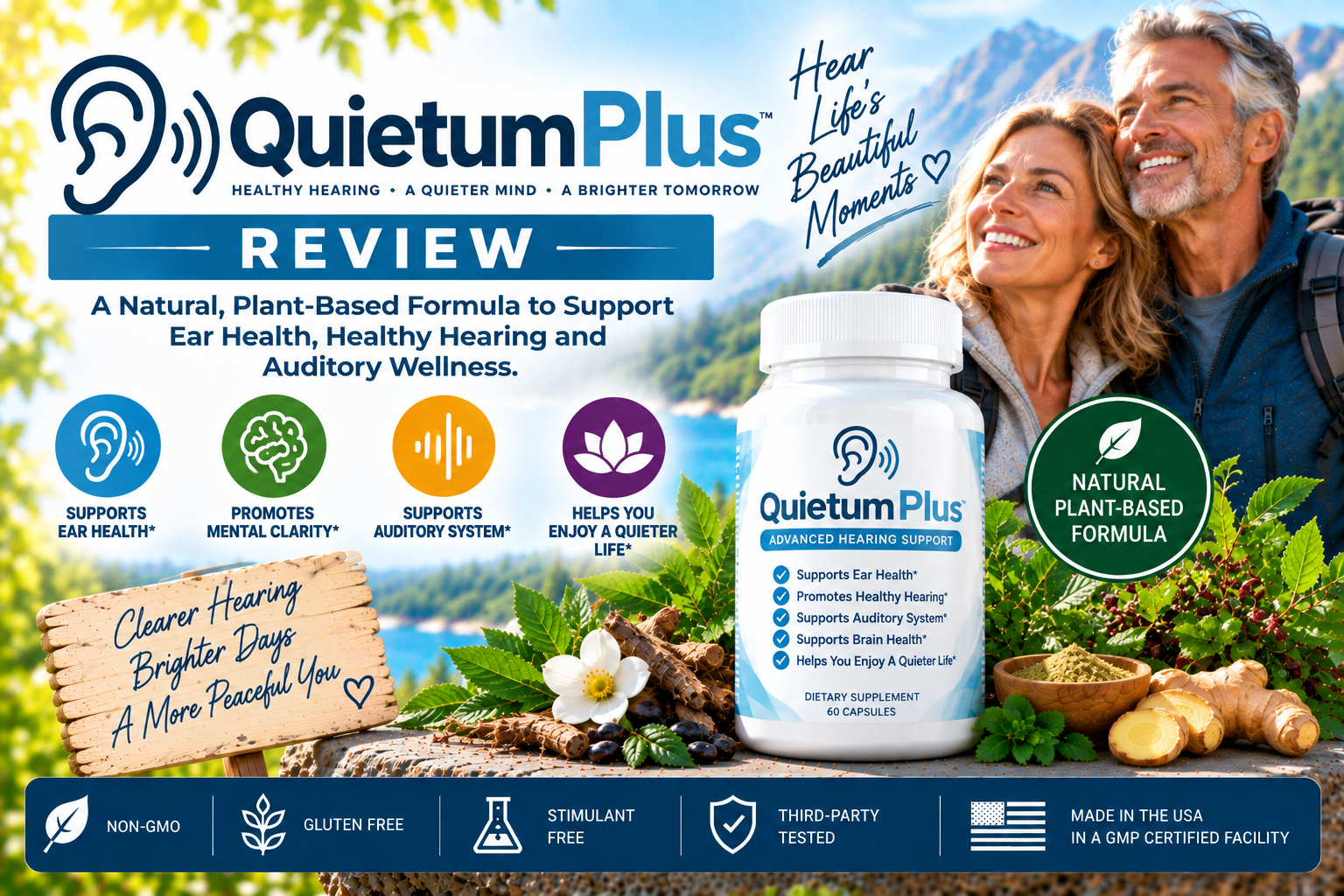
Quietum Plus is a dietary supplement designed specifically around these areas.
According to the manufacturer, Quietum Plus combines a proprietary selection of plant extracts, vitamins, minerals and amino acids intended to support healthy hearing, the auditory system, brain health and a quieter, more peaceful everyday experience.
The current product page describes a formula containing 18 highlighted ingredients or ingredient groups, including:
- Mucuna Pruriens
- Maca Root
- Epimedium
- Tribulus Terrestris
- Dong Quai
- Muira Puama
- Ginger
- Catuaba
- Damiana
- Ashwagandha
- Piperine
- Sarsaparilla Root
- Asparagus
- Vitamin A
- Vitamin B
- Zinc
- L-Tyrosine
- L-Arginine
Several of these ingredients have legitimate nutritional or botanical properties.
However, the manufacturer’s much stronger claims involving tinnitus, neural repair and restoring hearing go substantially beyond what can confidently be concluded from the ingredient list.
In this independent Quietum Plus review, we’ll examine the ingredients, potential benefits, hearing and tinnitus claims, safety considerations and limitations.
This review is based on the manufacturer’s published product information and available ingredient research. We have not personally used or tested Quietum Plus.
What Is Quietum Plus?
Quietum Plus is a capsule-based dietary supplement marketed primarily for ear health and healthy hearing.
The current manufacturer’s website focuses on several overlapping themes:
- Ear health
- Healthy hearing
- Hearing support
- Auditory health
- Auditory system support
- Brain health
- Nervous-system support
- Ear ringing
- Buzzing and whooshing
- Tinnitus support
- A quiet and peaceful mind
- Antioxidant support
- Healthy circulation
The formula combines botanical extracts with vitamins, minerals and amino acids.
According to the manufacturer, Quietum Plus is:
- A natural formula
- Non-GMO
- Gluten-free
- Stimulant-free
- Non-habit-forming
- Easy to use
These characteristics may appeal to adults looking for a non-stimulant hearing health supplement.
They don’t, however, establish that Quietum Plus can treat tinnitus or restore hearing loss.
How Does Quietum Plus Work?
Quietum Plus is marketed around a theory connecting the ears and brain.
The manufacturer describes a neural “wire” that carries electrical signals and sounds from ear cells to brain networks.
There is a legitimate concept underneath this simplified description.
Sound waves entering the ear are converted into electrical signals, and auditory nerves transmit information toward the brain, where those signals are processed as sound.
The manufacturer then argues that damage to this neural pathway is the fundamental cause of ear ringing and hearing difficulties.
Quietum Plus is presented as supplying nutrients that help “feed, regenerate and rebuild” this pathway.
This is where the explanation becomes considerably more speculative.
Tinnitus doesn’t have one universal cause.
It can be associated with hearing loss, noise exposure, ageing, ear disorders, medications and numerous other factors.
Neural changes within the auditory system can indeed play a role in tinnitus.
But that doesn’t establish a single damaged “wire” as its universal root cause, nor does it demonstrate that Quietum Plus rebuilds auditory nerves.
The more reasonable interpretation is that Quietum Plus provides botanical and nutritional ingredients intended to support general neurological, circulatory and auditory wellness.
Quietum Plus Ingredients
Mucuna Pruriens
Mucuna Pruriens, sometimes called velvet bean, is a tropical legume with a long history of traditional use.
It naturally contains L-DOPA, a precursor to the neurotransmitter dopamine.
This makes Mucuna biologically active rather than simply a general nutritional herb.
The Quietum Plus manufacturer associates Mucuna with nervous-system support, inflammation and neuronal recovery.
Research into Mucuna is more commonly associated with neurological conditions and its L-DOPA content than with hearing.
There isn’t strong evidence establishing Mucuna as a treatment for tinnitus.
Because of its L-DOPA content, medication interactions are also worth considering.
Maca Root
Maca, or Lepidium meyenii, is an Andean root widely used in supplements targeting energy, vitality and general wellbeing.
Quietum Plus pairs Maca with Mucuna and associates the combination with nervous-system support.
Human research involving Maca has investigated areas including mood, energy and sexual wellness.
Its direct evidence for improving hearing or tinnitus is much less established.
Maca is therefore better regarded as a general wellness component rather than a primary hearing ingredient.
Epimedium
Epimedium, sometimes known as horny goat weed, contains compounds including icariin.
Research has explored antioxidant, cardiovascular and neurological properties of Epimedium compounds, particularly in laboratory and animal studies.
Quietum Plus associates Epimedium with neuroinflammation, antioxidant protection and mood.
Those mechanisms are scientifically interesting.
They don’t demonstrate that oral Epimedium restores damaged auditory pathways or eliminates tinnitus.
Tribulus Terrestris
Tribulus Terrestris is another traditional botanical.
It is commonly found in supplements marketed for vitality, exercise performance and sexual wellness.
Quietum Plus combines it with Epimedium and describes potential antioxidant and mood-related benefits.
There is limited convincing evidence directly linking Tribulus supplementation with improved hearing.
Its contribution should therefore be regarded as supportive rather than central to the product’s auditory-health rationale.
Dong Quai
Dong Quai, or Angelica sinensis, is a traditional Chinese botanical.
Quietum Plus describes Dong Quai as an “ear tonic” and associates it with brain-cell health and auditory acuity.
Dong Quai has been studied primarily in relation to traditional women’s health applications, circulation and various biological pathways.
Evidence demonstrating that Dong Quai improves hearing acuity in humans is limited.
The manufacturer’s “ear tonic” terminology should therefore be understood as traditional or promotional language rather than an established clinical classification.
Muira Puama
Muira Puama is a South American botanical traditionally used as a tonic.
Quietum Plus pairs it with Ginger and highlights antioxidant and nerve-support concepts.
Scientific research involving Muira Puama is comparatively limited, particularly in humans.
There isn’t good evidence establishing it as a treatment for tinnitus or hearing loss.
Ginger
Ginger, or Zingiber officinale, is one of the better-known ingredients in the formula.
It contains compounds such as gingerols and shogaols and has been investigated extensively for antioxidant and inflammatory pathways.
Quietum Plus associates Ginger with protection against free radicals and nerve health.
Those properties provide a plausible general wellness rationale.
However, antioxidant activity doesn’t establish an ability to regenerate auditory nerves or reverse hearing damage.
Catuaba
Catuaba refers to botanical preparations traditionally used in Brazil and other parts of South America.
It is commonly associated with vitality and nervous-system wellness.
Quietum Plus pairs Catuaba with Damiana and associates the combination with circulation, neuroprotection and brain health.
Human evidence remains limited.
Its inclusion is more consistent with the formula’s broader brain and nervous-system support concept than with a clinically established hearing effect.
Damiana
Damiana, or Turnera diffusa, has a history of traditional herbal use.
It is frequently marketed for mood, relaxation and general vitality.
The Quietum Plus manufacturer connects Damiana with healthy circulation and neuroprotective activity.
While laboratory findings involving plant compounds can be interesting, they don’t establish that Damiana improves tinnitus or hearing in humans.
Ashwagandha
Ashwagandha, or Withania somnifera, is one of the more extensively studied botanical ingredients in Quietum Plus.
It is generally categorized as an adaptogen.
Human research has investigated Ashwagandha particularly in relation to:
- Stress
- Anxiety
- Sleep
- Physical performance
- General wellbeing
This could have indirect relevance for someone distressed by persistent ear noise.
Stress doesn’t necessarily cause tinnitus, but stress and tinnitus can interact, with each potentially making the other feel worse.
Ashwagandha therefore has a more plausible role in stress and wellbeing support than as a direct treatment for ear ringing.
Piperine
Piperine is a compound found in black pepper.
It is frequently added to supplements because it can alter the absorption and metabolism of other compounds.
This is sometimes described as improving bioavailability.
That can be useful, but it also creates an important safety consideration.
Piperine can potentially affect the way certain medications are metabolized.
People taking prescription medicines should therefore discuss multi-ingredient supplements containing Piperine with an appropriate healthcare professional.
Sarsaparilla Root
Sarsaparilla is a traditional botanical historically used for a wide range of wellness purposes.
Quietum Plus associates it with nervous-system “detoxification,” nerve-tissue health and cognitive performance.
The term detoxifying the nervous system isn’t a clearly established medical process in this context.
The body already has sophisticated mechanisms for processing and eliminating unwanted compounds, particularly through the liver and kidneys.
There isn’t strong clinical evidence demonstrating that Sarsaparilla detoxifies auditory nerves or removes tinnitus-causing toxins.
Asparagus
Asparagus contains numerous nutrients and plant compounds.
The manufacturer pairs it with Sarsaparilla and associates the combination with nerve health and cognition.
While asparagus can certainly form part of a nutritious diet, its presence in a proprietary hearing supplement shouldn’t be interpreted as evidence of hearing restoration.
Vitamin A
Vitamin A is essential for numerous normal physiological functions, including vision, immune function and cellular development.
Nutritional deficiencies can affect many body systems.
However, taking additional Vitamin A beyond nutritional requirements doesn’t automatically improve hearing.
Excessive Vitamin A intake can also be harmful.
The total amount supplied by Quietum Plus should therefore be considered alongside other supplements and dietary sources.
Vitamin B
The Quietum Plus website refers broadly to Vitamin B rather than clearly identifying the specific B vitamin in the main ingredient presentation.
B vitamins have important roles in energy metabolism, neurological function and red-blood-cell health.
Some specific B-vitamin deficiencies can produce neurological symptoms.
But “Vitamin B” is too broad a description to infer a particular hearing benefit.
Consumers should check the current Supplement Facts panel for the exact vitamin and dose.
Zinc
Zinc is an essential mineral required for immune function, protein synthesis and numerous enzymatic processes.
It has also been investigated in tinnitus research.
The evidence is mixed.
Zinc supplementation may be particularly relevant to someone who is genuinely zinc deficient, but evidence doesn’t establish Zinc as a universal treatment for tinnitus.
More isn’t necessarily better, either.
Excessive long-term Zinc intake can contribute to copper deficiency and other problems.
L-Tyrosine
L-Tyrosine is an amino acid involved in the production of catecholamine neurotransmitters including dopamine and norepinephrine.
It is commonly included in supplements targeting cognitive performance, particularly during stressful or demanding situations.
Quietum Plus associates L-Tyrosine with mood.
There isn’t strong evidence that it directly improves hearing or eliminates tinnitus.
L-Arginine
L-Arginine is an amino acid and precursor to nitric oxide.
Nitric oxide contributes to normal blood-vessel regulation.
This provides a plausible connection to the manufacturer’s circulation-focused claims.
However, improving general nitric-oxide biology doesn’t establish that L-Arginine restores hearing.
It can also interact with certain medications and may influence blood pressure.
Potential Benefits of Quietum Plus
1. May Provide Nutritional Support for Ear Health
Quietum Plus contains vitamins, minerals, amino acids and botanical compounds.
Some of these nutrients are relevant to normal neurological and cellular function.
This provides a reasonable basis for describing the product as offering nutritional ear-health support.
That is different from claiming it reverses hearing loss.
2. May Support the Auditory System
The manufacturer’s core concept involves supporting communication between the ears and brain.
Several ingredients have neurological, antioxidant or circulatory properties that make this an interesting nutritional concept.
However, evidence that the complete formula measurably improves auditory-nerve function hasn’t been established.
3. Provides Antioxidant Support
Ginger and several other botanical ingredients contain compounds with antioxidant activity.
Oxidative stress has been investigated in relation to many aspects of neurological and auditory health.
Providing antioxidant compounds may therefore contribute to general wellness.
But antioxidant activity by itself doesn’t establish a tinnitus treatment.
4. May Support Stress Management
Ashwagandha provides one of the clearer rationales here.
Persistent tinnitus can be stressful, and stress can make tinnitus feel considerably more intrusive.
Supporting stress management may therefore help some people cope with unwanted ear noise even without changing the underlying auditory signal.
This is an important distinction.
Feeling calmer about tinnitus isn’t necessarily the same as eliminating tinnitus.
5. May Support Healthy Circulation
L-Arginine and several botanical ingredients have relationships with vascular or circulatory biology.
Healthy circulation is important throughout the body.
However, this doesn’t mean increasing circulation automatically improves tinnitus, since tinnitus has many possible mechanisms.
6. Provides Stimulant-Free Hearing Support
The manufacturer describes Quietum Plus as containing no stimulants.
That may appeal to consumers who don’t want a hearing supplement containing caffeine or stimulant-heavy nootropic ingredients.
This could be particularly relevant for people who find stimulants interfere with sleep or increase feelings of anxiety.
Quietum Plus and Tinnitus
Although the main product page often uses softer phrases such as ear health and healthy hearing, Quietum Plus is clearly marketed toward people experiencing tinnitus-like symptoms.
The company’s video presentation specifically references:
- Ringing
- Buzzing
- Clicking
- Pulsing
- Whooshing
This is where expectations need to be carefully managed.
Tinnitus is the perception of sound without a corresponding external source.
It can sound like ringing, buzzing, humming, hissing, clicking or other noises.
It isn’t a single disease.
Instead, it is a symptom associated with numerous possible causes and risk factors.
That complexity makes claims of a single “root cause” particularly questionable.
Does Quietum Plus Stop Ear Ringing?
There isn’t sufficient evidence to conclude that Quietum Plus reliably stops ear ringing.
The manufacturer’s marketing includes testimonials describing dramatic improvements and promotes the formula directly to people experiencing ringing, buzzing and whooshing.
Testimonials don’t establish clinical effectiveness.
Some ingredients may potentially support general neurological, nutritional or stress-related wellness.
That doesn’t establish that the complete product eliminates tinnitus.
Anyone buying Quietum Plus specifically to stop tinnitus should therefore maintain realistic expectations.
What Causes Tinnitus?
Potential contributors to tinnitus include:
- Age-related hearing loss
- Noise-induced hearing damage
- Earwax blockage
- Ear infections
- Certain medications
- Ménière’s disease
- Head or neck injuries
- Jaw problems
- Vascular conditions
- Neurological changes within auditory pathways
Sometimes no obvious cause can be identified.
This is why the idea that all tinnitus originates from one damaged neural “wire” is too simplistic.
The auditory system is considerably more complicated.
Does Quietum Plus Repair Auditory Nerves?
The manufacturer uses language suggesting Quietum Plus helps feed, regenerate and rebuild the neural pathway connecting ear cells with brain networks.
This is a strong claim.
Research into nerve regeneration and auditory-neural function is a legitimate scientific field.
But demonstrating biological mechanisms in laboratory research is very different from demonstrating that an oral supplement rebuilds damaged auditory nerves in people.
We did not identify evidence establishing that the finished Quietum Plus formulation regenerates the human auditory nerve.
This claim should therefore remain clearly attributed to the manufacturer.
Can Quietum Plus Restore Hearing Loss?
Quietum Plus should not be presented as a proven way to restore lost hearing.
Hearing loss can result from many different problems.
Some causes—such as impacted earwax—may be reversible with appropriate treatment.
Sensorineural hearing loss caused by damage to inner-ear structures or auditory pathways is often permanent.
The manufacturer’s affiliate materials use particularly strong phrases implying “perfect” hearing.
That language goes well beyond what can responsibly be concluded from the product’s ingredient evidence.
Anyone noticing hearing deterioration should obtain an appropriate hearing assessment rather than relying solely on a supplement.
Quietum Plus for Brain Health
The manufacturer also positions Quietum Plus around brain health.
This makes sense from a general nutritional perspective because hearing isn’t performed by the ears alone.
The brain plays a fundamental role in interpreting auditory signals.
Ingredients such as Ashwagandha, L-Tyrosine and Mucuna also have more obvious neurological connections than direct hearing-specific effects.
However, describing a supplement as supporting brain health doesn’t mean it prevents neurological disease.
The same evidence limitations apply.
Quietum Plus and Sleep
Tinnitus frequently becomes more noticeable at night because environmental sound levels decrease.
For some people, this can make falling asleep difficult.
Quietum Plus isn’t primarily a sleep supplement.
However, its broader marketing associates a quieter mind with relaxation, and the company currently provides sleep-related bonus material with some packages.
Ashwagandha also has human research relevant to stress and sleep.
Anyone experiencing tinnitus-related insomnia may benefit from evidence-based sleep strategies and tinnitus-management techniques in addition to considering supplements.
How Do You Take Quietum Plus?
The current purchasing information describes two bottles as a 60-day supply.
That indicates one bottle is intended to provide approximately one month of supplementation.
However, consumers should follow the exact serving instructions printed on the current physical Quietum Plus label rather than relying on assumptions from package duration.
This is particularly important for a proprietary multi-ingredient formula.
Do not exceed the recommended serving in an attempt to obtain faster results.
How Long Does Quietum Plus Take to Work?
The manufacturer’s promotional materials imply that some users may notice changes relatively early and encourage longer-term supplementation.
Those timelines should be treated as marketing expectations rather than clinically established outcomes.
There is no reliable way to predict whether an individual will experience a change in tinnitus after taking Quietum Plus.
For persistent tinnitus, objective hearing evaluation and appropriate management are more important than waiting several months for a supplement to work.
Is Quietum Plus Natural?
According to the current official product page, Quietum Plus is marketed as:
- Natural Formula
- Non-GMO
- Gluten-Free
- No Stimulants
- Non-Habit-Forming
- Easy To Use
The manufacturer also says its ingredients are tested for purity and contaminants.
These characteristics may be useful when comparing hearing supplements.
They do not demonstrate effectiveness for tinnitus.
Is Quietum Plus FDA Approved?
This point deserves clarification because the manufacturer’s pages use inconsistent wording.
One official FAQ says Quietum Plus is manufactured in what it calls an “FDA-approved facility.”
Another company support page more accurately acknowledges that dietary supplements aren’t individually reviewed and approved by the FDA in the way pharmaceutical drugs are.
Therefore, Quietum Plus should not be described as FDA-approved.
Manufacturing or registering a facility within an FDA regulatory framework is different from the FDA evaluating and approving the supplement for treating tinnitus or hearing loss.
Is Quietum Plus Safe?
A multi-ingredient botanical supplement isn’t automatically suitable for everyone simply because its ingredients are natural.
Several Quietum Plus ingredients are biologically active.
For example:
Mucuna Pruriens naturally contains L-DOPA and may be particularly relevant for people using neurological or psychiatric medications.
Piperine can influence drug metabolism.
Dong Quai may be relevant to people taking anticoagulant medication.
L-Arginine may influence blood pressure and interact with cardiovascular medications.
Ashwagandha can interact with certain medications and isn’t appropriate in every health situation.
The manufacturer itself recommends showing the bottle to a doctor before use if you have a medical condition or take prescription medication.
That is sensible advice.
Quietum Plus Side Effects
Potential side effects depend on the complete formula, doses and individual sensitivity.
Possible problems associated with ingredients in a multi-botanical formula can include:
- Digestive discomfort
- Nausea
- Headache
- Dizziness
- Changes in blood pressure
- Drowsiness
- Allergic reactions
- Medication interactions
Because Mucuna contains L-DOPA, its presence deserves particular consideration for anyone taking medications that affect dopamine.
The same applies to Piperine because of its potential effect on drug metabolism.
Anyone experiencing a significant adverse reaction should stop taking the product and seek appropriate advice.
Quietum Plus Limitations
The “Root Cause” Explanation Is Oversimplified
Tinnitus doesn’t have one universal cause.
The manufacturer’s damaged neural-wire explanation simplifies a complex auditory and neurological phenomenon.
Neural-Regeneration Claims Aren’t Established
There isn’t sufficient evidence that taking Quietum Plus rebuilds damaged auditory nerves in humans.
Ingredient Studies Aren’t Product Studies
Research into Ashwagandha, Ginger, Zinc or other individual ingredients doesn’t prove the complete Quietum Plus formulation produces equivalent outcomes.
The Formula Is Proprietary
The website describes a proprietary formula.
When exact standardized extracts and doses aren’t transparent, it becomes harder to compare the product directly with doses used in clinical research.
Testimonials Aren’t Clinical Evidence
The website includes customer stories describing major improvements in ringing, buzzing and quietness.
These testimonials cannot establish causation or predict what another person will experience.
It Doesn’t Replace a Hearing Assessment
Persistent tinnitus or hearing loss can sometimes reveal an underlying medical or audiological problem.
Taking a supplement shouldn’t delay appropriate investigation.
Quietum Plus Money-Back Guarantee
The current official website advertises a 60-day, 100% money-back guarantee.
According to the current guarantee wording, customers can try Quietum Plus for up to 60 days and request a refund if dissatisfied.
One current version says customers should return all bottles, whether empty or not, along with the packing slip.
Another official support page uses slightly different wording regarding unused bottles.
Because refund wording can differ between pages, buyers should save the terms displayed at checkout and verify the exact return requirements applying to their order.
The advertised 60-day period nevertheless provides a relatively substantial evaluation window.
Who Might Consider Quietum Plus?
Quietum Plus may appeal to adults who:
- Want additional nutritional hearing support
- Are interested in ear-health supplements
- Want a formula targeting auditory wellness
- Prefer stimulant-free supplements
- Want a non-GMO formula
- Prefer gluten-free supplements
- Are interested in botanical nervous-system support
- Want antioxidant and nutritional support
- Understand that tinnitus supplements have evidence limitations
- Have realistic expectations about hearing supplements
It is considerably less appropriate as a substitute for investigating unexplained or worsening hearing symptoms.
Quietum Plus vs Hearing Aids
Quietum Plus and hearing aids serve fundamentally different purposes.
Hearing aids are regulated medical devices designed to amplify and process sound for people with hearing loss.
Quietum Plus is a dietary supplement designed to provide nutritional and botanical support.
There isn’t evidence that Quietum Plus can replace hearing aids when amplification is clinically appropriate.
Someone struggling to hear conversations, television or everyday environmental sounds should consider a professional hearing assessment rather than avoiding hearing aids because of supplement marketing.
Quietum Plus vs Tinnitus Sound Therapy
Sound therapy uses external sounds to reduce the contrast between tinnitus and a quiet environment.
This can help make tinnitus less intrusive for some people.
Quietum Plus takes a nutritional approach instead.
These aren’t necessarily competing concepts.
Someone experiencing persistent tinnitus may use professionally recommended sound-management techniques, stress reduction and other evidence-based strategies while separately discussing nutritional supplementation with their healthcare professional.
Supporting Hearing Health Naturally
No hearing supplement is more important than protecting the ears from preventable damage.
One of the most effective strategies is limiting exposure to excessive noise.
Use appropriate hearing protection around:
- Loud machinery
- Concerts
- Power tools
- Motorcycles
- Firearms
- Other high-volume environments
Listening volume through headphones and earbuds also matters.
General cardiovascular health may contribute to healthy ageing throughout the body, including structures involved in hearing.
Useful habits include regular physical activity, balanced nutrition, not smoking, adequate sleep and managing blood pressure and metabolic health.
When Tinnitus Needs Medical Attention
Tinnitus is common, but certain patterns deserve prompt assessment.
Seek professional advice for:
- New persistent tinnitus
- Tinnitus affecting only one ear
- Pulsatile tinnitus that beats with your pulse
- Sudden hearing loss
- Rapidly worsening hearing
- Severe dizziness or vertigo
- Ear pain or discharge
- Neurological symptoms
- Tinnitus beginning after a head injury
Sudden hearing loss can be a medical emergency and should be assessed urgently.
A supplement should never delay evaluation of these symptoms.
Final Verdict: Is Quietum Plus Worth Trying?
Quietum Plus is a multi-ingredient dietary supplement designed around ear health, healthy hearing, auditory-system support and a quieter everyday experience.
Its formula is unusually broad.
The current product page describes 18 plant extracts, nutrients and amino acids, including:
Mucuna Pruriens, Maca Root, Epimedium, Tribulus Terrestris, Dong Quai, Muira Puama, Ginger, Catuaba, Damiana, Ashwagandha, Piperine, Sarsaparilla Root, Asparagus, Vitamin A, Vitamin B, Zinc, L-Tyrosine and L-Arginine.
There are legitimate nutritional concepts within this formula.
Zinc is an essential mineral and has been investigated in tinnitus research, although results are mixed.
Ashwagandha has meaningful human research involving stress and wellbeing.
Ginger provides antioxidant compounds.
L-Arginine participates in nitric-oxide biology.
Several additional botanicals have traditional neurological or circulatory applications.
That gives Quietum Plus a plausible basis as a general nutritional hearing and nervous-system support supplement.
Where the product becomes considerably less convincing is its stronger marketing.
The idea that tinnitus universally results from one damaged neural “wire” is an oversimplification.
Claims that Quietum Plus can regenerate this pathway, eliminate ringing or restore perfect hearing aren’t established by clinical evidence for the finished product.
Those distinctions are particularly important because tinnitus and hearing loss can have numerous causes.
Overall, Quietum Plus is best viewed as an optional dietary supplement intended to support ear health, healthy hearing, brain health and auditory wellness.
It should not be viewed as a proven tinnitus treatment, a method for regenerating auditory nerves or a substitute for hearing aids and professional hearing care.
The manufacturer’s current natural, non-GMO, gluten-free and stimulant-free positioning may appeal to people specifically looking for a botanical hearing supplement, while the advertised 60-day money-back guarantee reduces some of the purchasing risk.
The ingredient list is interesting enough to make Quietum Plus relevant within the hearing-supplement category.
The evidence, however, supports much more modest expectations than some of the advertising suggests.
👉 To learn more please click here to visit the product website.
Leave a Reply
You must be logged in to post a comment.